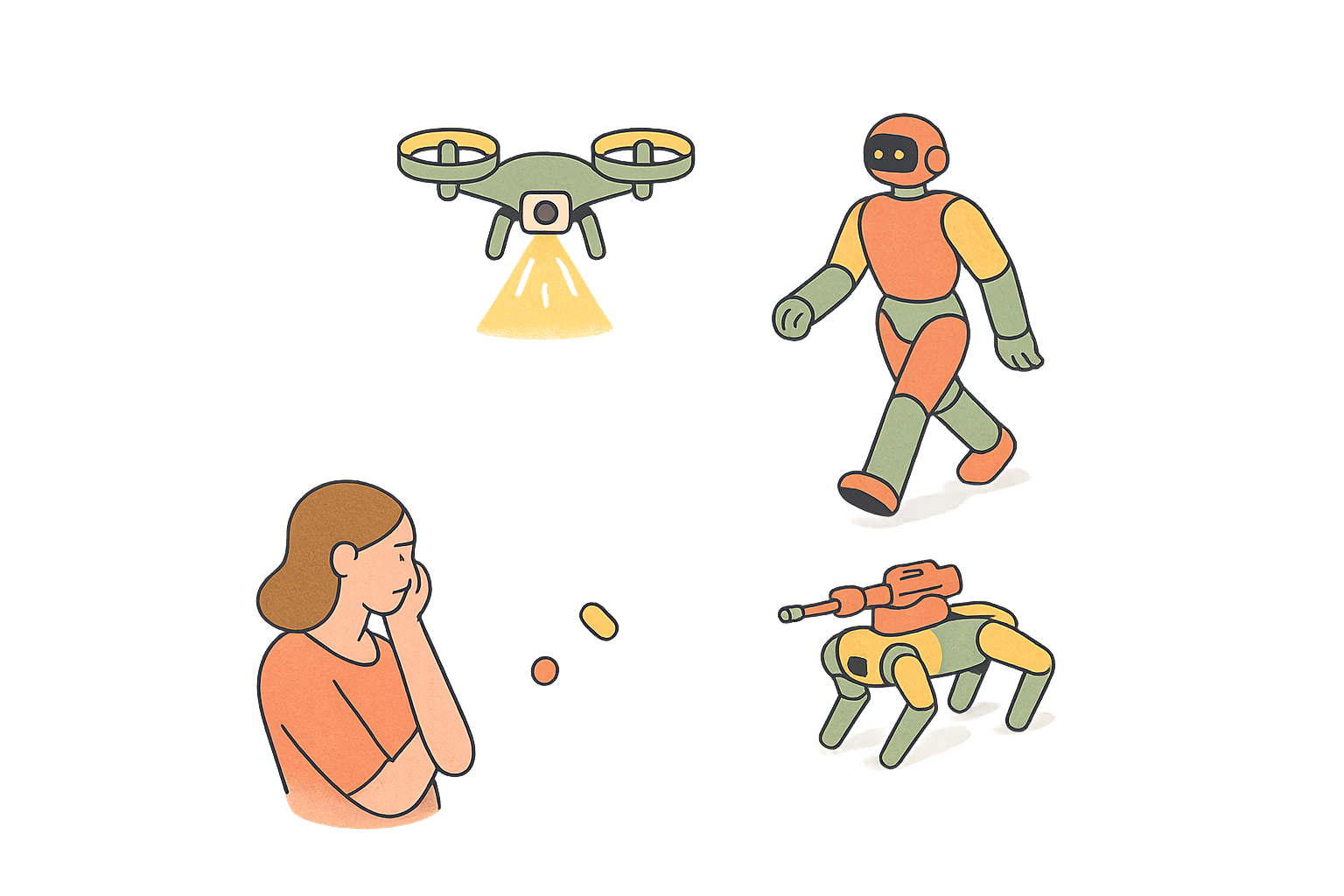
The anxious question of our age is no longer whether machines will enter public life. They already have. The more difficult question is how far they will be allowed to go before citizens, lawmakers and institutions decide that efficiency has met its proper limit.
That is why the sight of police drones, patrol robots and ever more autonomous weapons unsettles people in a way that many other technologies do not. A washing machine saves labour. A search engine saves time. A drone that watches, tracks or even helps choose a target alters the distribution of power. It extends the reach of the state. It dilutes the visibility of decision-making. It makes force feel cleaner to those who wield it and more impersonal to those who live under it.
None of this is science fiction. Police forces in several countries have expanded drone use for surveillance and emergency response. Governments and security agencies have experimented with robotic patrol systems in public spaces. On battlefields, autonomy is already advancing in practice, even where the official language still insists on “human oversight”. The operator may remain somewhere in the chain, yet the direction of travel is plain: faster systems, thinner supervision, greater dependence on software in situations where judgment, restraint and accountability matter most.
An individual cannot halt that movement alone. That recognition need not lead to despair. Modern technological systems are not acts of nature. They are funded, procured, regulated and justified by human institutions. They can be slowed, redirected and bounded. History offers many examples. Societies have imposed rules on chemical weapons, landmines, biological research, aviation safety, pharmaceutical testing and data protection. The progress of technology has rarely been stopped outright. It has often been disciplined.
The first practical response, then, is to refuse the false choice between helpless resignation and total withdrawal. Going to a remote island may spare one some noise, though not the consequences of the wider world. Supply chains, climate, disease, geopolitics and finance have a way of reaching even the places that imagine themselves distant. Retreat can be a personal remedy for exhaustion. It is not a public answer.
A better course begins with clarity. One must distinguish between tools that assist humans and systems that quietly transfer human responsibility to opaque processes. A drone used to find a missing hiker is not morally interchangeable with software that helps select people for lethal force. A robot that carries supplies is different in kind from one authorised to coerce. Democratic societies need that discrimination, because the language of innovation has a habit of smoothing over differences that are ethically immense.
From there, politics becomes unavoidable. Organising a movement may sound grandiose; in practice it often means something modest and durable: supporting civil-liberties groups, backing journalists who investigate procurement and deployment, pressing elected representatives for legal limits, insisting on audit trails, human accountability and public scrutiny. The United Nations, the Red Cross and human-rights organisations have all warned about the dangers of autonomous weapons and argued for meaningful human control. Such phrases may sound procedural. In fact they protect something elemental: the idea that responsibility for violence must remain attributable to human beings.
That still leaves the private question: how to live while history takes an unnerving turn. The answer, unsatisfying though it may seem, is to keep living seriously rather than passively. Build local bonds. Cultivate useful competence. Stay informed without becoming consumed. Participate where one’s effort can matter. Technological progress often appears irresistible when viewed from too far away. Up close, it depends on many permissions. Some are legal. Some are cultural. Some are moral.
The task is not to hope the world avoids error by itself. It is to help preserve the habits and institutions that make correction possible. The future may indeed grow more automated, more surveilled and more remote in its uses of force. That is precisely why human beings must become more deliberate, not less. Calmness is not surrender. It is what allows judgment to survive fashion, fear and the rhetoric of inevitability.
Citations: Reuters on humanoid robot races and public fascination with robotics; The Guardian on the expansion of police drones as first responders; The Guardian on patrol robots and surveillance concerns in Singapore; UN Security Council coverage from December 19, 2024 on AI, conflict and the need for guardrails; UN statements and documents from 2025 on autonomous weapons and meaningful human control; International Committee of the Red Cross materials on autonomous weapon systems and accountability; CSIS analyses on AI-enabled autonomy in contemporary warfare; Human Rights Watch report from April 2025 on autonomous weapons, surveillance and human rights.