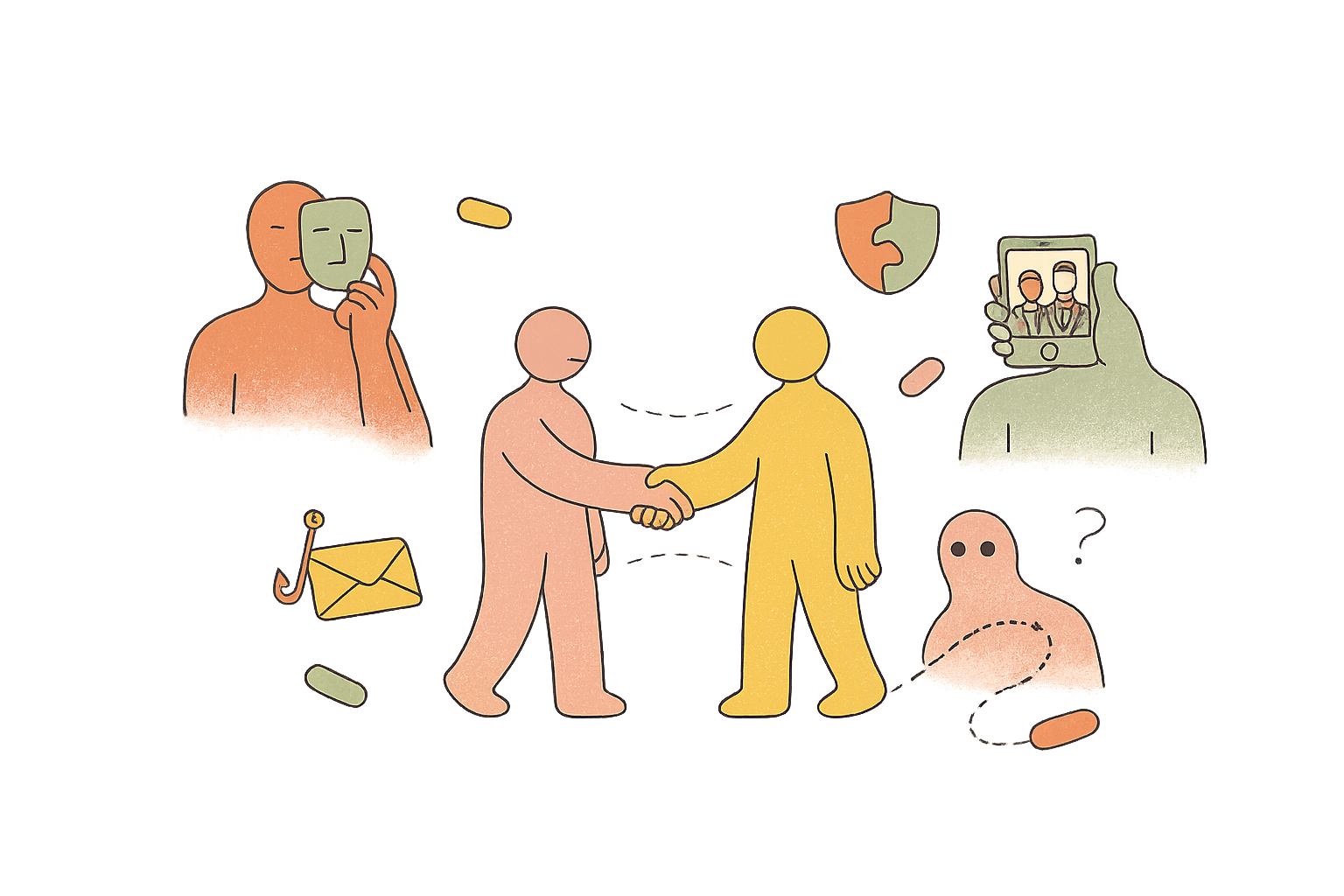
The internet once promised a strange and valuable social freedom. It allowed people to discover one another outside the usual limits of geography, class, workplace or family circle. A shared interest, a niche joke, a forum post at the right moment: these were often enough to begin a real connection. That promise has not vanished, though it is being steadily weakened by a more basic problem, which is trust.
Generative AI has made fakery cheap. Images that once required skill now require a prompt. A persuasive biography can be produced in seconds. A voice can be cloned from a short clip. A face can be invented, a backstory assembled, a pattern of messages automated. The old clues that helped people judge authenticity online were never perfect, but they existed. One could inspect a profile picture, a posting history, a writing style, a social graph. All of these signals are now easier to fabricate at scale.
This matters because social discovery depends on a degree of ambient confidence. Strangers must seem at least provisionally real. Once that confidence erodes, the incentives change. Caution replaces curiosity. Every unsolicited message begins to look like a pitch, a phishing attempt or a synthetic persona trying to pass as human. The online world becomes noisier and more transactional. Discovery still occurs, though under suspicion.
The evidence is accumulating quickly. Regulators and police forces have warned that AI-generated impersonation is amplifying fraud. In Hong Kong, officials described a deepfake video conference scam in which an employee was induced to transfer large sums after seeing convincing digital impersonations of senior executives. Singapore and Hong Kong police later reported recovering funds in another case involving deepfake-style business impersonation. Consumer-protection agencies in America and elsewhere have also warned that voice cloning and fabricated identities are making impersonation scams more believable and more scalable.
The effect is broader than outright crime. It changes the social texture of the internet. If fake profiles, bot activity and synthetic media become common enough, then online identity begins to lose its evidential value. A profile no longer suggests a person in the ordinary sense; it suggests a possibility. Even when an account belongs to a real human being, others may hesitate to treat it as such. That hesitation is corrosive. It does not destroy digital relationships among people who already know one another, but it makes the first step harder.
Hence a subtle shift in what the internet is for. Increasingly, it looks less like a place to meet people and more like a place to maintain contact with people met elsewhere: in schools, workplaces, group chats, private communities, neighbourhoods and introductions through mutual acquaintances. Social platforms start to function more like address books with messaging features attached. They remain useful for keeping up, coordinating, signalling presence and preserving weak ties. Their role in initiating trust declines.
That may produce a more closed internet. Discovery moves behind gates: private groups, verified communities, paid networks, invitation-only circles, smaller newsletters, niche servers, events with some offline anchor. In one sense this is a rational adaptation. When the open web fills with counterfeits, people retreat to places where identity is vouched for by context. Yet something is lost when openness becomes too costly. Serendipity becomes rarer. So does the democratic quality of meeting people without prior credentials.
None of this means online life is finished. People adapt, and so do institutions. Better authentication, stronger platform enforcement and clearer provenance tools will help at the margins. Even so, the larger direction seems plain. As AI lowers the cost of imitation, trust becomes scarcer and more valuable. The internet will continue to connect people. Its great change may be that connection increasingly follows prior trust rather than creating it.
Sources: Federal Trade Commission; Hong Kong Government Information Services; Singapore Police Force; INTERPOL; Hong Kong Privacy Commissioner for Personal Data; Ofcom.