The human eye inhabits a remarkably narrow corridor of reality. Visible light spans only a small slice of the electromagnetic spectrum, roughly 400 to 700 nanometres, while the wider spectrum stretches from long radio waves and microwaves through infrared and ultraviolet to X-rays and gamma rays. From an engineering point of view, this looks like a limitation. From a civilisational point of view, it may be one of nature’s more merciful design decisions.
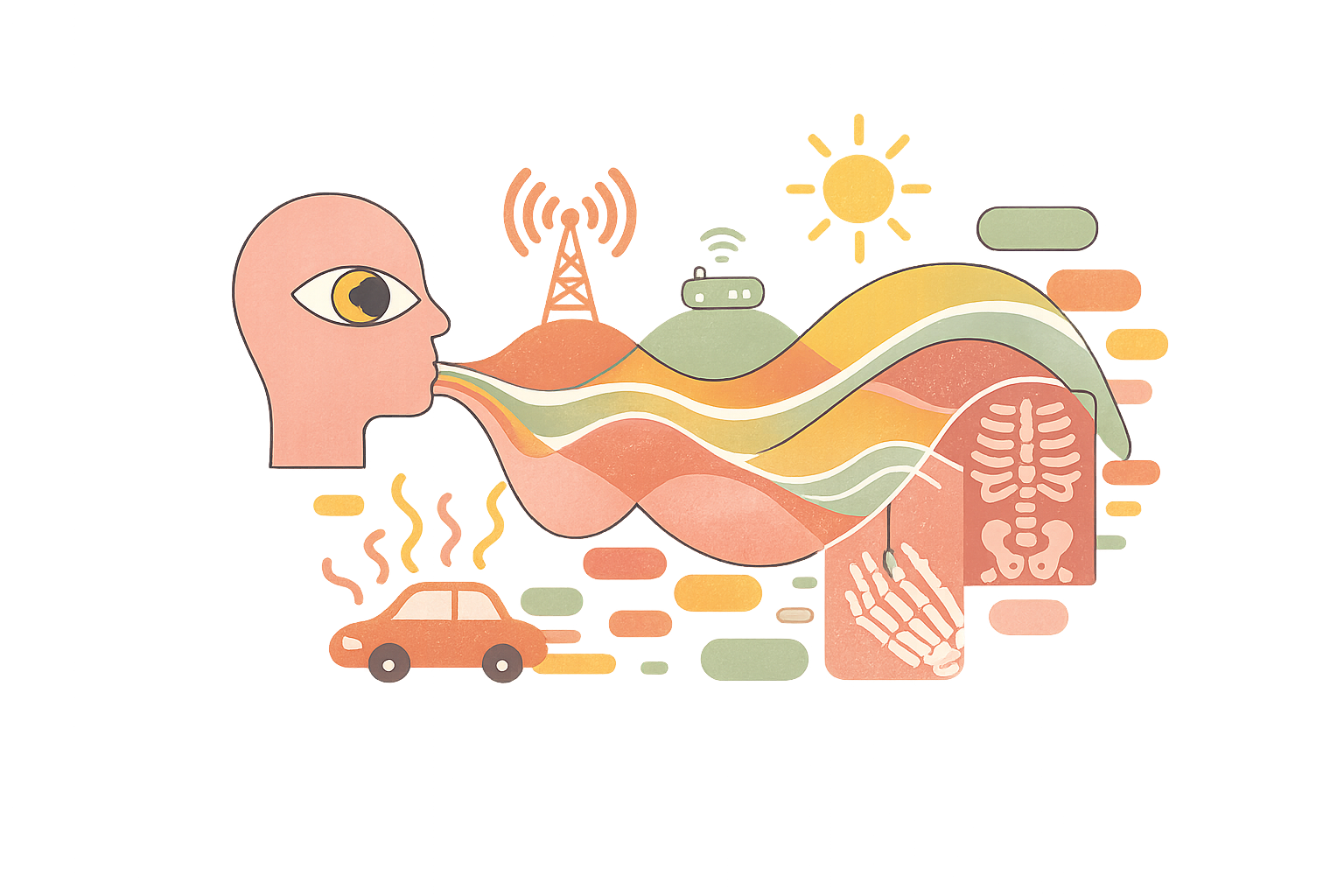
One can imagine the alternative. If human beings could directly see the whole electromagnetic spectrum, modern life would be visually ferocious. A city street would not merely present buildings, trees and traffic. It would also shimmer with radio transmissions, pulse with Wi-Fi routers, glow with phone signals, leak heat from engines and windows, and flare with ultraviolet patterns now hidden from us. Every room would become crowded with information. The air itself would seem occupied.
There is some reason to think our current visual range is no accident of pure arbitrariness. The Sun emits strongly in the visible and near-infrared bands, and Earth’s atmosphere is comparatively transparent across much of that region. Human vision evolved within a useful “window”: enough solar illumination reaches the ground there, and biological tissues can build photoreceptors that respond to it. Our retinas, with their rods and three types of cones, are already performing an extraordinary compression task, converting a torrent of photons into a manageable picture of edges, motion, colour and contrast. Expanding that system to cover the whole spectrum would not simply add more colours. It would require a radically different sensory architecture and, most likely, a much heavier cognitive burden.
Technology would have developed differently under such conditions. Much of telecommunications relies on the practical invisibility of radio and microwave signals. If wireless networks were plainly visible, designers might have been forced into shielding, directional confinement or entirely different standards much earlier, simply to preserve visual sanity. Architecture would have become an exercise in spectral hygiene. Offices and homes might be judged not only by acoustics and lighting, but by how little electromagnetic clutter they projected into the eye. Fashion, too, would have changed. Clothing could serve as optical filtering, more akin to noise-cancelling for vision.
Yet the largest change might have been psychological rather than technical. Human attention is a scarce resource. The visible world already competes hard enough for it. If every appliance announced itself in infrared, every transmitter flashed in microwave bands and every hot surface blazed with intensity, urban life would feel less like seeing and more like triage. Evolution often favours useful omission. A nervous system that suppresses irrelevant detail gains clarity, speed and focus. In that sense, blindness to most of the spectrum resembles the brain’s other acts of editing: we do not hear every vibration, smell every molecule or consciously track every heartbeat. Perception is selective because consciousness has finite bandwidth.
There is, of course, a price to this narrowness. We need instruments to detect what other creatures or machines can register more directly. Bees can see ultraviolet nectar guides invisible to us. Thermal cameras reveal patterns of heat that our bodies sense only dimly. Radio telescopes and X-ray observatories had to be invented before the universe disclosed many of its workings. Human ignorance has often been overcome by extending the senses artificially.
Still, that may be the deeper point. The hidden spectrum gave rise to science because it was hidden. Since we could not see it, we learned to infer, measure and model it. Our ignorance became methodical rather than merely passive. A species born seeing everything at once might have been less curious, even as it was more overwhelmed.
Perhaps, then, our visual confinement is not a defect to lament. It is a filter that makes the world legible. Civilisation depends as much on what the mind can ignore as on what it can perceive.
Citations: Encyclopaedia Britannica on the visible spectrum, rods and cones, colour vision, rhodopsin, and ultraviolet effects; NASA educational materials on the electromagnetic spectrum; National Eye Institute materials on retinal photoreceptors.