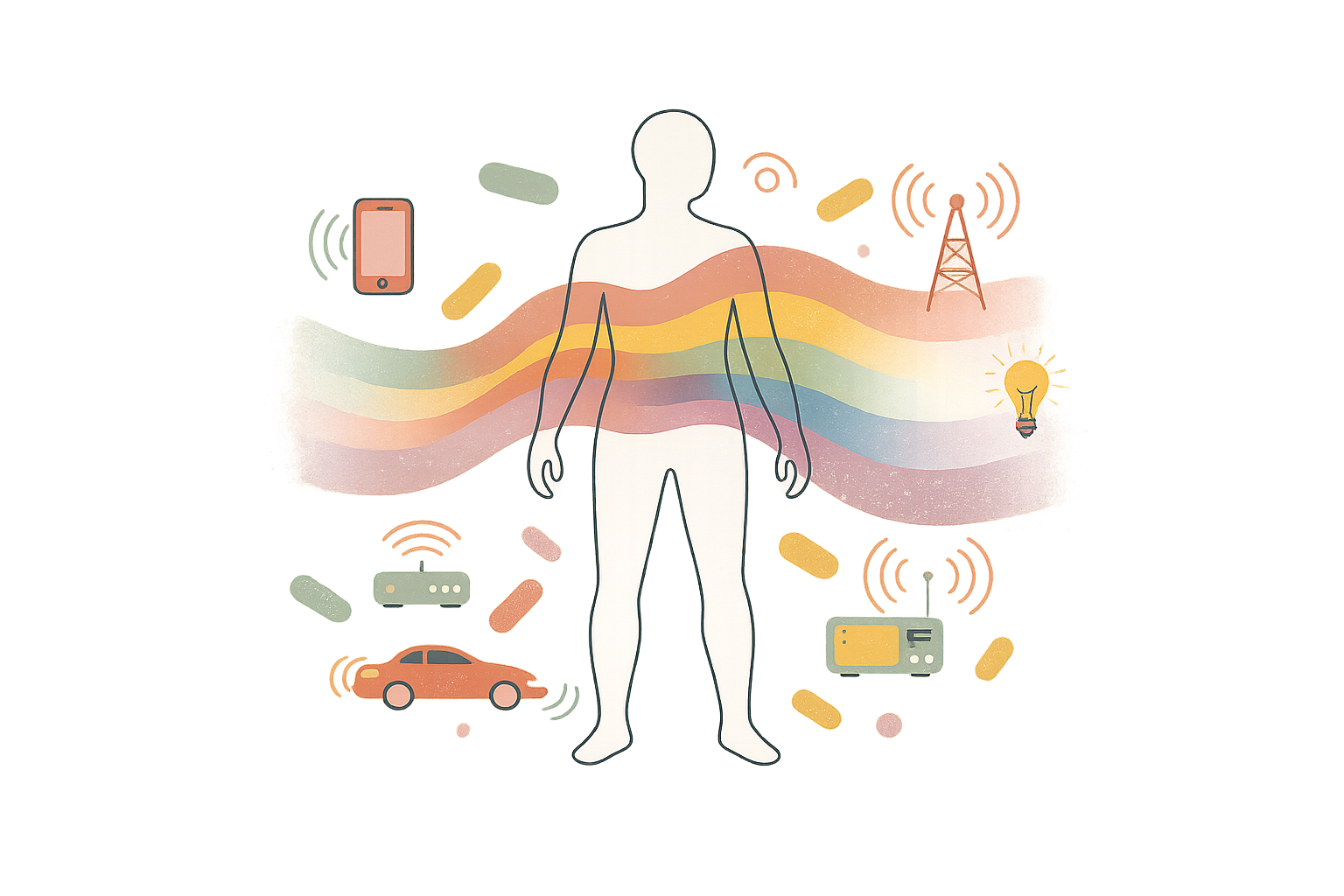
One can imagine the appeal of seeing the whole electromagnetic spectrum. The fantasy has a childlike neatness: no more invisible radio signals, no hidden heat, no ultraviolet lurking beyond the violet edge of the rainbow. The room would glow with router chatter, a phone would pulse in the pocket, and every appliance would advertise its workings in light. Yet the more one thinks about it, the more human sight, narrow though it is, begins to look less like a defect than a settlement with the world.
Human vision occupies a remarkably small band of the spectrum, roughly the wavelengths where sunlight is abundant and Earth’s atmosphere is comparatively transparent. That is not an accident. Evolution tends to make use of information that is available, reliable and worth the metabolic expense of processing. Visible light serves those purposes well. It reflects off surfaces in ways that preserve shape, edge and colour. It works at the distances that matter to a terrestrial primate. It is energetic enough to carry detail, but not so energetic as to be routinely destructive, as ultraviolet can be.
Beyond that band, the world grows harder to interpret. Infrared often tells one more about temperature than about texture. Radio waves pass through walls, which is useful for communication and dreadful for ordinary seeing, because vision depends on surfaces stopping and reflecting light in legible ways. Microwaves and radio are also immensely longer in wavelength than visible light, making fine spatial resolution difficult without very large receiving structures. A species that could “see” Wi‑Fi would not necessarily behold crisp floating runes in the air. It might instead register a muddle of diffuse interference, reflections and signal noise.
Nature offers clues. Some animals extend perception modestly beyond the human range. Bees see ultraviolet patterns on flowers. Mantis shrimps possess unusually elaborate photoreceptor systems and can detect ultraviolet and polarisation cues. Even so, these are not creatures drowning in total electromagnetic omniscience. Their senses are tailored to specific ecological tasks: finding nectar, signalling, hunting, navigating. Biology does not reward maximal input. It rewards useful input.
That principle would almost certainly have shaped technology differently. If humans could directly perceive radio and microwave emissions, engineers might have been forced to design calmer electromagnetic environments, just as cities eventually learned to regulate smoke, glare and noise. Wireless standards might have prioritised visual unobtrusiveness alongside bandwidth. Buildings could have evolved as electromagnetic blinds, with shielding as common as insulation. Screens, lamps and signage might have looked less revolutionary, because a large part of modern technology’s magic lies in making invisible processes legible on demand.
There is also a deeper point about cognition. Modern life already suffers from surplus stimulus. Human attention is scarce because the world presents more signals than the mind can honour. Add the full spectrum and one does not simply gain knowledge; one acquires clutter. Every warm engine, every remote control, every transmission tower, every sunlit surface radiating heat would compete for notice. Perception would require a far more aggressive system of filtering than the one we possess. In effect, the brain would have to recreate invisibility in order to function.
So the inability to see everything may indeed be a gift, though not in a mystical sense. It is a practical mercy. The visible spectrum is less a prison than a well-edited brief: enough information to navigate, recognise, judge distance, read faces and make tools. Civilisation itself depends on selective blindness. Science progresses by building instruments that reveal the hidden only when needed, in measured and interpretable form. A spectrum analyser is preferable to permanent spectral overload.
To see less, in this case, is to understand more. The limitation is not merely a lack. It is one of the conditions that make an intelligible world possible.
Sources: NASA Earth Observatory; NIST Special Publication 800-48; Scientific Reports; Nature Communications; Proceedings of the Royal Society B; Scientific American.