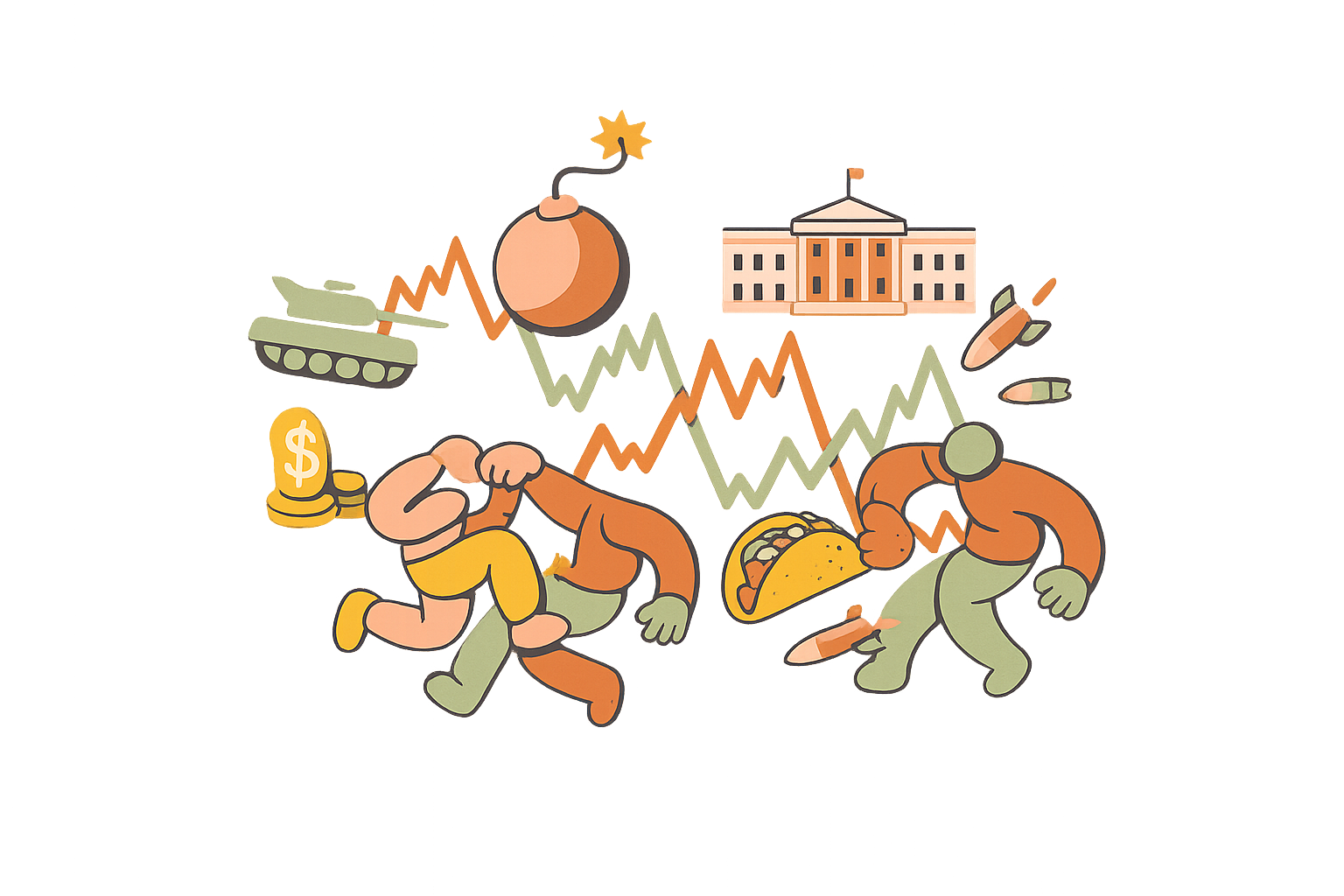
The oddity of this market moment is not that investors are calm. It is that they appear to have developed a method for pricing chaos. The swirl of tariff threats, legal brinkmanship, institutional stress and geopolitical improvisation ought, in a simpler world, to have produced a more durable loss of confidence. Instead, each lurch has increasingly been treated as a volatility event rather than a regime change.
Part of the answer lies in a crude but influential market doctrine: TACO, the Wall Street shorthand coined in 2025 to describe the belief that Donald Trump escalates, alarms markets, then retreats before maximum damage is done. The phrase is juvenile; the logic is not. Investors have observed a pattern in which policy threats are framed in absolutist terms, risk assets sell off, bond markets wobble, and the White House moderates or delays. By mid-2025, even the IMF’s improved growth outlook rested partly on the fact that the United States had paused some of the most extreme tariff steps announced in April. Markets learned the lesson quickly. Threats remained real, yet so did the possibility that they were opening bids in a negotiation rather than the settled architecture of policy.
That does not mean investors trust the politics. It means they trust the constraints. American presidents can frighten markets; they cannot fully command them. Treasury yields, corporate credit spreads, the dollar, business lobbying, court challenges and the Federal Reserve all function as feedback mechanisms. The modern market has spent years absorbing shocks that once seemed unthinkable: Brexit, a pandemic, an inflation surge, a European land war, regional bank failures and repeated geopolitical flare-ups. That history has taught investors to distinguish between noise, damage and irreversibility. Most political drama belongs in the first category. Markets tend to reserve genuine panic for the third.
Another reason for resilience is that “the market” is a misleadingly broad term. The headline indices are dominated by giant firms with unusually strong balance sheets, global revenue streams and, in the case of the largest technology companies, business models only indirectly exposed to tariffs and political theatre. Concentration has made equity benchmarks look sturdier than the wider economy may be. If a handful of cash-rich firms continue to deliver earnings growth, especially around artificial intelligence and digital infrastructure, they can hold the index up even while smaller companies and trade-sensitive sectors struggle below the surface.
There is also a structural bid under American assets. US households remain large holders of equities, and institutional investors still treat American markets as the deepest and most liquid destination for capital. Even critics of Washington continue to rely on Wall Street. The United States enjoys a peculiar privilege: investors can lose faith in parts of its politics while continuing to believe in its courts, its central bank, its corporate sector and the sheer gravitational pull of dollar markets. Rule of law in America is not trusted as immaculate; it is trusted as eventually operative. For markets, “eventually” often suffices.
Still, resilience should not be mistaken for innocence. Markets may be underreacting rather than seeing clearly. Repeated reversals can create moral hazard: if traders assume every threat will be watered down, one day they will be wrong. The TACO thesis works until it fails. A policy error that sticks, a legal rupture that is not quickly repaired, or a bond-market revolt severe enough to tighten financial conditions sharply would expose the complacency embedded in current prices. The IMF and the Federal Reserve have both warned that elevated policy uncertainty and trade tensions raise financial stability risks, even when headline growth remains intact.
So yes, markets may have “gotten used to unpredictability”. More precisely, they have learned to trade unpredictability as a pattern. They are betting that American institutions, market discipline and presidential self-interest still place an outer limit on disorder. That is a rational wager, up to a point. Yet it rests on a dangerous assumption: that every flirtation with rupture remains theatrical. History suggests institutions are strongest until, suddenly, they are asked to prove it.
Sources: Financial Times terminology as reported by AP and CNBC; IMF World Economic Outlook, April 2025 and July 2025 update; IMF Global Financial Stability Report, April 2025; Federal Reserve Financial Stability Report, April 2025; Goldman Sachs research on household and family-office equity demand; State Street SPY holdings data; reporting from AP, The Guardian and South China Morning Post.