At 35,000 feet, death can feel oddly abstract. The cabin lights are dimmed, the engine note becomes a kind of mechanical lullaby, and the mind, stripped of errands and signal, drifts toward first principles. Mine often drifts toward death. I have long thought that if a plane were falling from the sky, I would not be especially afraid. This has always struck other people as either bravado or pathology. Yet the feeling seems simple enough. Fear belongs to situations in which one still has something to do. If a man with a knife were chasing me down a street, terror would be appropriate: there would be decisions to make, corners to turn, some final reserve of cunning or speed to summon. On a doomed aircraft, by contrast, there is no hidden competence waiting to be discovered. I am not a pilot. I cannot bargain with gravity. At such a moment, panic would have nowhere to go.
This, at least, is the fantasy of helplessness: that surrender is a form of peace. It depends on a neat, cinematic idea of death—instantaneous, decisive, over in a blaze. Many of us imagine mortality as an on-off switch. One moment there is consciousness, the next there is none. The appeal of that picture lies partly in its brevity. It asks little of us except acceptance.
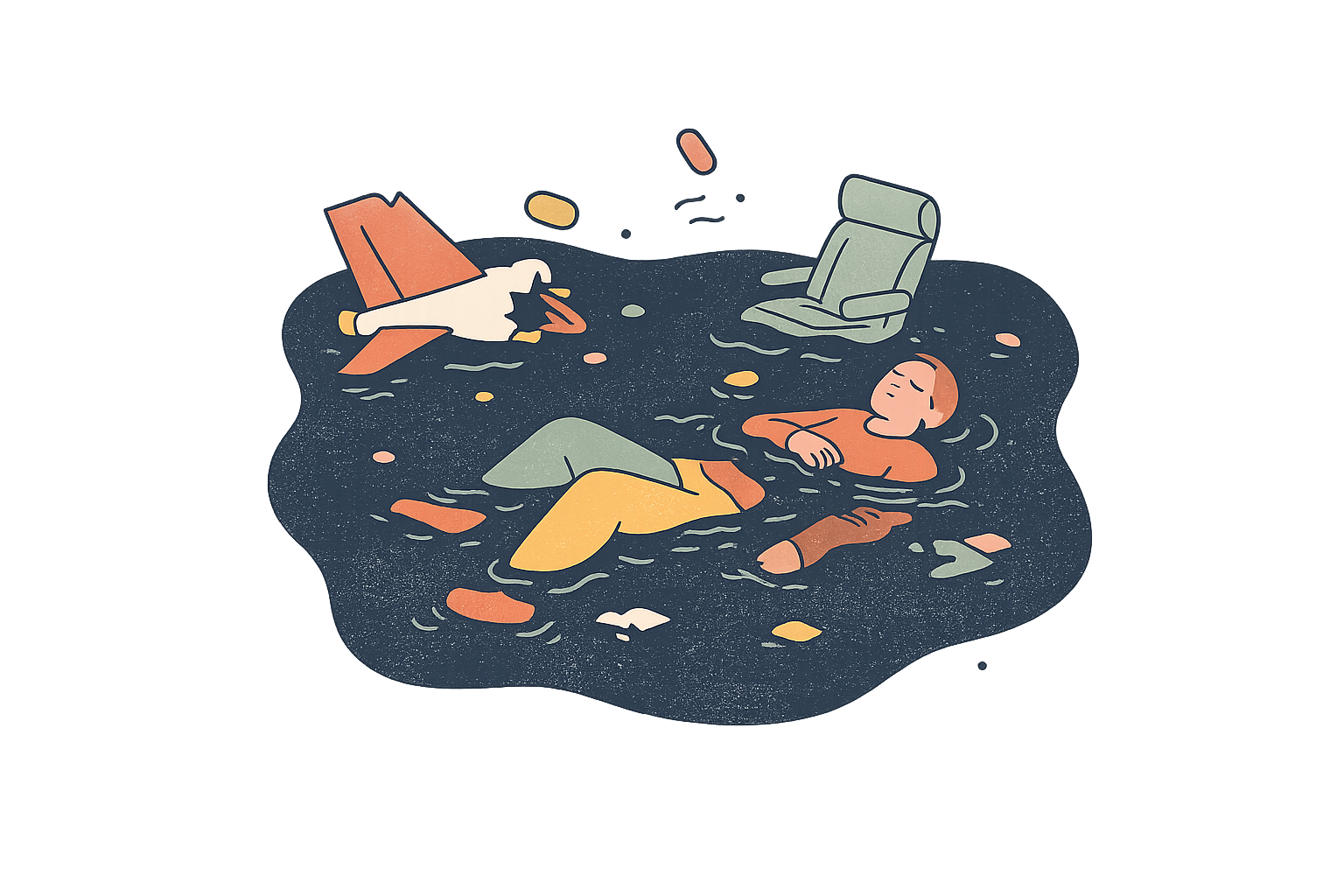
What unsettles me more is a different possibility, and I suspect it is closer to the truth of catastrophe. The plane does not explode. It hits the Pacific hard, breaks apart, and leaves me improbably alive: neck aching, lungs working, body intact enough to understand what has happened. I am floating in black water among scraps of metal and upholstery, thousands of miles from anywhere, while the wreckage slips beneath me. Death has not arrived cleanly. It has become an administrative problem. Now there is agency again, which means there is fear.
That distinction matters. Human beings are often less frightened by extinction than by ordeal. Psychologists have long observed that fear intensifies when control is uncertain rather than absent. Total powerlessness can produce resignation; partial powerlessness produces torment. The mind begins calculating. How cold is the water? How long before muscles fail? Should I conserve energy or swim toward nothing? In aviation water landings, surviving the impact is only the beginning of the struggle. Rescue guidance and survival literature dwell on cold shock, disorientation, inhalation of water and the swift onset of panic. Sudden immersion can provoke involuntary gasping and chaos in the body before reason has time to intervene. The sea turns survival into a test not merely of strength, but of composure.
This is why the second image of death feels more terrible than the first. It contains hope, and hope can be cruel. A fireball closes the account at once. Open water offers a ledger of possibilities. Perhaps rescue will come. Perhaps it will not. Perhaps one’s task is simply to float and wait. Perhaps waiting is another name for despair. The body keeps issuing demands long after the soul would prefer to withdraw its application. One must keep trying, even when trying has become a prolonged acknowledgement of one’s insignificance.
There is also loneliness in this version that exceeds the fact of dying. To perish instantly is to be removed from the world. To survive briefly in the middle of nowhere is to remain in it under impossible terms. The ocean, in that imagination, is not dramatic. It is indifferent. That may be the colder thought. Death itself can be accepted in the abstract; abandonment is harder. We do not merely fear the end. We fear being left conscious on its threshold, responsible for ourselves in a place where responsibility has become absurd.
Perhaps that is what those airborne meditations are really about. I do not think I am unafraid of death. I think I am more afraid of the long corridor that may lead to it: the interval in which action is still required, dignity is hard to maintain, and the world offers no sign that effort will be rewarded. “Que sera, sera” is easy to say when fate promises swiftness. It is much harder to say when fate leaves you floating.
Citations: RNLI water safety guidance on cold water shock and drowning risk; SKYbrary aviation safety guidance on emergency evacuation on water and post-ditching exposure; FAA aviation physiology materials on survival and psychological aspects after ditching; Flight Safety Foundation digest on survivor experiences after water ditching.