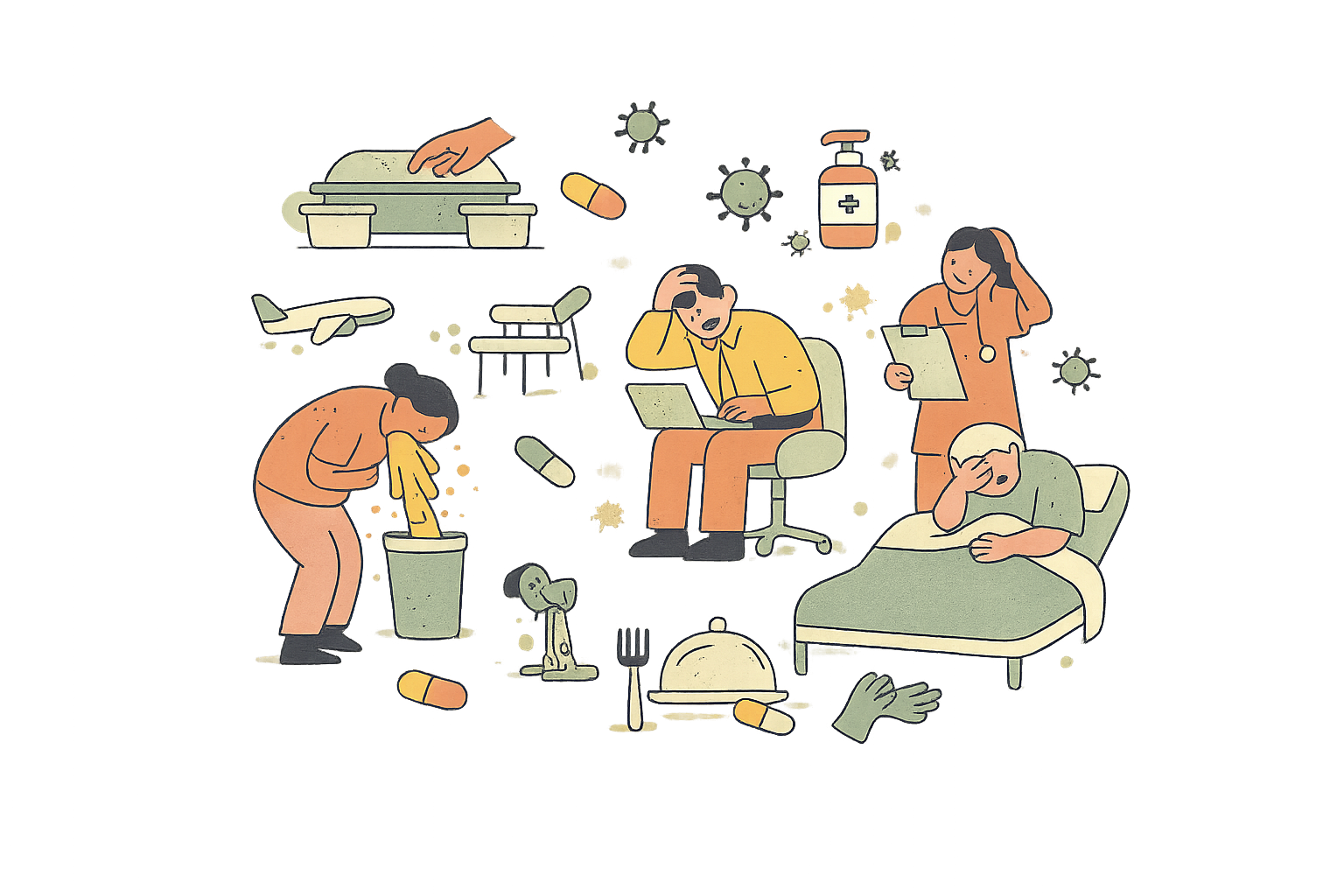
If the next great global pathogen were shaped less like Covid than like norovirus, modern life would be tested in a peculiarly demoralising way. Covid threatened lungs, hospitals and mortality on a mass scale. A norovirus-like pandemic would menace daily function itself. The world would not shut down because everyone feared death. It would stagger because people could not reliably stay upright, travel, teach, serve food, care for patients or sit through a meeting without wondering who, exactly, was carrying the next bout of two days’ misery.
That thought experiment is unnerving because norovirus already offers a sketch of the problem. It is extraordinarily contagious, spreads through contaminated surfaces, food, water, close contact and even particles released during vomiting, and can infect with a tiny dose. A substantial share of infections are asymptomatic. Viral shedding may begin before symptoms and continue long afterwards, sometimes for weeks. Immunity is real yet frustratingly brief and incomplete. Reinfection across a lifetime is common. In rich countries, this is usually filed under “winter vomiting bug”, a nuisance rather than a civilisation-shaping event. Scale it up into a persistent global pattern and the nuisance becomes a governing principle.
The social consequences would differ sharply from those of Covid. Death rates might be lower, yet the appetite for restrictions could be weaker too, precisely because the illness was “merely” excruciating rather than usually fatal. That would create a modern political trap. Governments would struggle to justify sweeping controls for a disease that left most people alive but repeatedly incapacitated. Citizens, having endured years of argument over masks, closures and emergency powers, would be in no mood for a sequel. Employers would be reluctant to tolerate endless disruption. Schools would become revolving doors of absence. Hospitality, aviation, cruise travel, elder care and hospitals would live in a near-permanent state of outbreak management.
One can imagine a new etiquette of bodily suspicion. The office worker who says he is “a bit off” would be treated as a saboteur. Buffet dining might start to feel as anachronistic as the communal cigarette. Hand hygiene, air handling, surface disinfection and paid sick leave would cease to be the fussy concerns of infection-control enthusiasts and become core economic infrastructure. A world organised around frictionless presence would have to rediscover the value of staying away.
That, in turn, would expose an old weakness in liberal societies: they are comfortable asking people to isolate for dramatic emergencies, less adept at redesigning institutions for chronic unpleasantness. Yet chronic unpleasantness is exactly what this scenario implies. If some people carried the virus harmlessly while seeding recurrent agony in others, the familiar language of personal responsibility would start to break down. Telling people to be careful means little when infectiousness is invisible, immunity fades after a few months and transmission is built into ordinary life. The burden would shift from individual vigilance to system design: better sanitation rules, outbreak-resistant schools and workplaces, stronger protections for food handling, cleaner public toilets, more resilient staffing models, and serious investment in vaccines.
Here the lesson from Covid would cut both ways. The pandemic left behind scientific tools that would help: faster surveillance, genomic tracking, more acceptance of remote work, and a clearer understanding that public health is entangled with labour policy. It also left fatigue, mistrust and a taste for denial. Many would decide, loudly and often, that a disease which mostly does not kill should simply be endured. Endured by whom is the awkward question. Recurrent gastrointestinal illness is manageable for the healthy professional with a laptop. It is economically vicious for carers, cleaners, nurses, teachers, kitchen staff and anyone paid by the shift. As so often, the rhetoric of resilience would rest on somebody else’s body.
A norovirus-like pandemic would therefore reveal something bleakly contemporary. Societies do not reserve their deepest dysfunction for the deadliest threats. They often unravel just as readily when faced with relentless, unequal, hard-to-govern suffering. The pathogen would be milder than Covid in one sense and politically more insoluble in another. People would keep going out, going to work and going to school, until they couldn’t. Then they would recover, briefly, and begin again. Civilisation would continue. It would simply do so while clutching its stomach.
Citations: World Health Organization; US Centers for Disease Control and Prevention; Emerging Infectious Diseases; National Institutes of Health/PubMed Central studies on norovirus transmission, asymptomatic shedding, immunity and healthcare burden.