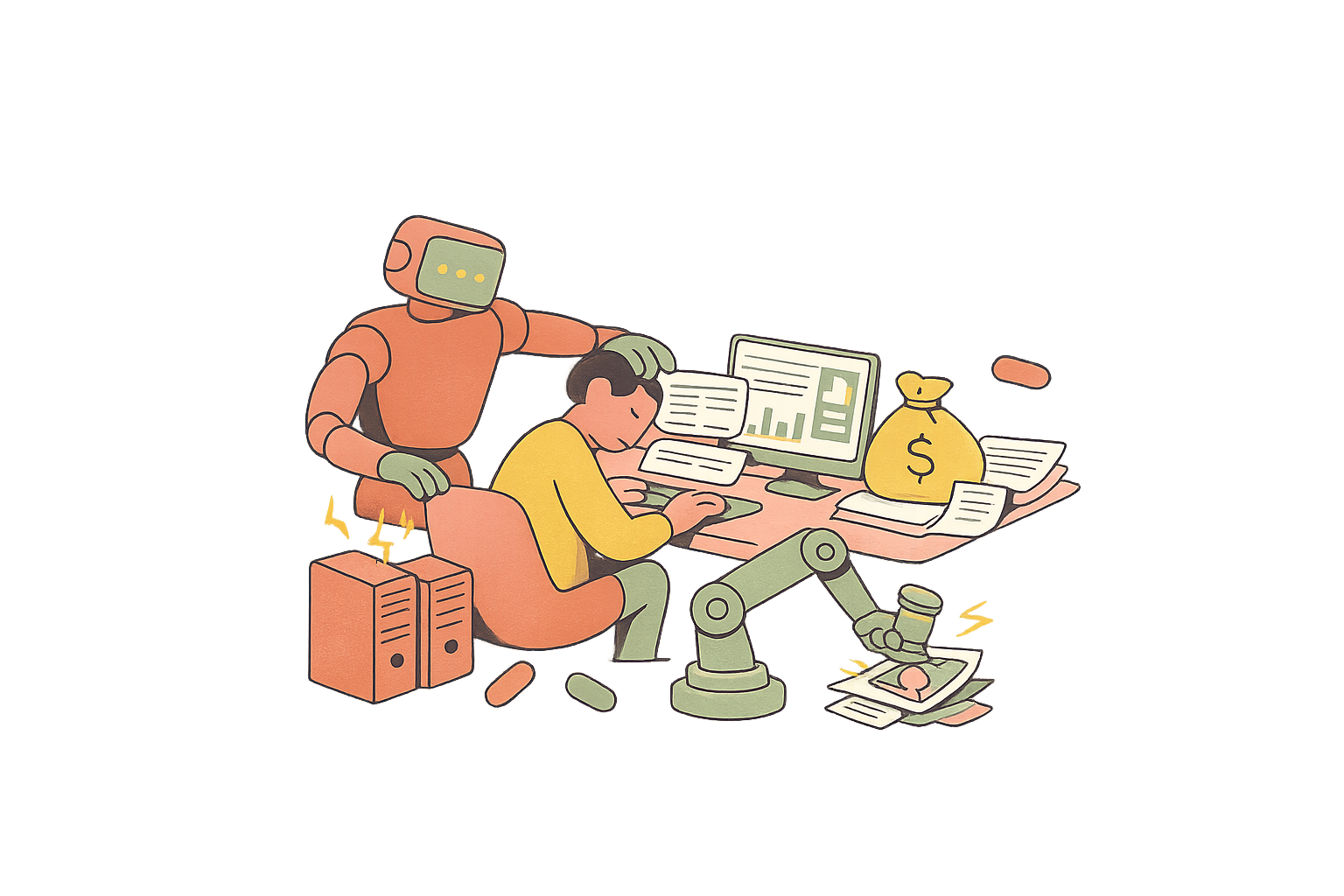
The case against artificial intelligence does not require panic, mysticism or a taste for Luddite theatrics. It requires only a sober look at what the industry is building, how it is financed, and who bears the cost. Strip away the evangelical language of “acceleration” and “inevitability”, and AI begins to resemble a familiar modern bargain: private gain wrapped in public risk, marketed as progress before its social ledger has been honestly drawn.
Begin with the economics. Generative AI has been sold as a productivity revolution, the next general-purpose technology that will rescue stagnant growth and automate drudgery. The evidence remains thinner than the rhetoric. There are controlled studies showing task-level gains in customer support, coding and certain forms of writing. Yet task improvement is not the same as economy-wide transformation. Even among firms adopting these tools, material effects on earnings remain elusive. In practice, much of the boom has consisted of expensive substitution: replacing junior researchers with autocomplete, replacing editors with summarisation, replacing search with probabilistic pastiche. The result may be less a leap in productivity than a redistribution of bargaining power away from labour and towards firms eager to cheapen white-collar work.
That redistribution matters because AI does not arrive in a neutral labour market. It enters one already shaped by insecurity, managerial surveillance and the hollowing-out of professional autonomy. Employers do not need machines that fully replace people in order to degrade work. They need systems that measure, standardise and fragment judgement, allowing skilled occupations to be broken into cheaper components. A generation of entry-level jobs in law, media, design, administration and software risks becoming thinner, more precarious and less educational. Apprenticeship suffers when the first rung of the ladder is removed. An economy cannot live forever off senior workers if it ceases to train juniors.
Then there is the question of theft, which the industry prefers to call training. The foundation of contemporary AI is the mass ingestion of human expression on an imperial scale: books, articles, photographs, illustrations, music, code and forum posts vacuumed into models whose commercial value depends on absorbing style, structure and knowledge without negotiating with most of the people who produced them. One may dress this up in the language of innovation, just as earlier empires spoke of civilising missions. It remains extraction. The machine’s apparent fluency is inseparable from an upstream seizure of cultural labour.
Nor is this a clean digital miracle. AI’s physical footprint is substantial and growing. Data centres are becoming large and hungry consumers of electricity, with some hyperscale AI facilities drawing power on the scale of small cities. Forecasts from energy authorities suggest that emissions from data-centre electricity use could rise markedly over the next decade. The industry likes to reply that AI may help optimise grids, logistics and industrial systems. Perhaps. Yet a technology whose benefits are speculative and uneven should not be granted an ecological indulgence in advance. A possible future gain does not erase a present demand for energy, water and hardware.
The political case is equally bleak. AI lowers the cost of generating persuasion, spam, surveillance and fraud. It industrialises impersonation. It rewards scale over accountability. Governments, predictably, are torn between fear of abuse and fear of missing out. Regulation is arriving, especially in Europe, because even enthusiasts have grasped that opaque systems trained on dubious material and deployed in sensitive settings create obvious hazards. But rule-making lags behind capital expenditure, and by the time safeguards appear, dependencies have often hardened.
The deepest objection, however, is philosophical. AI flatters a civilisation already inclined to confuse information with understanding and fluency with thought. It promises cheap substitutes for difficult human goods: expertise without study, companionship without reciprocity, art without experience, judgement without responsibility. It is a technology perfectly designed for institutions that want the appearance of intelligence without the inconvenience of people.
None of this means AI is useless. Calculators are useful. Spellcheck is useful. Pattern-recognition systems in bounded domains can be useful. The problem lies in the grander claim: that society should reorganise education, labour, culture and infrastructure around systems whose central commercial achievement is to monetise synthetic approximation. One can admire the engineering and still reject the politics.
And yes, to complete the satire, this denunciation has itself been fed through an AI model pipeline, tidied by the very machinery it condemns. That, too, is part of the problem.
Sources: International Energy Agency, “Energy and AI” (2025); OECD, “Generative AI and the SME Workforce” (2025); OECD, “Unlocking productivity with generative AI: Evidence from experimental studies” (2025); OECD, “Artificial Intelligence and the Changing Demand for Skills in the Labour Market” (2024); European Commission, “AI Act enters into force” (1 August 2024); European Parliament, “Artificial Intelligence Act: MEPs adopt landmark law” (2024); Reuters reporting on generative-AI copyright disputes and publisher/creator litigation (2024–2025).