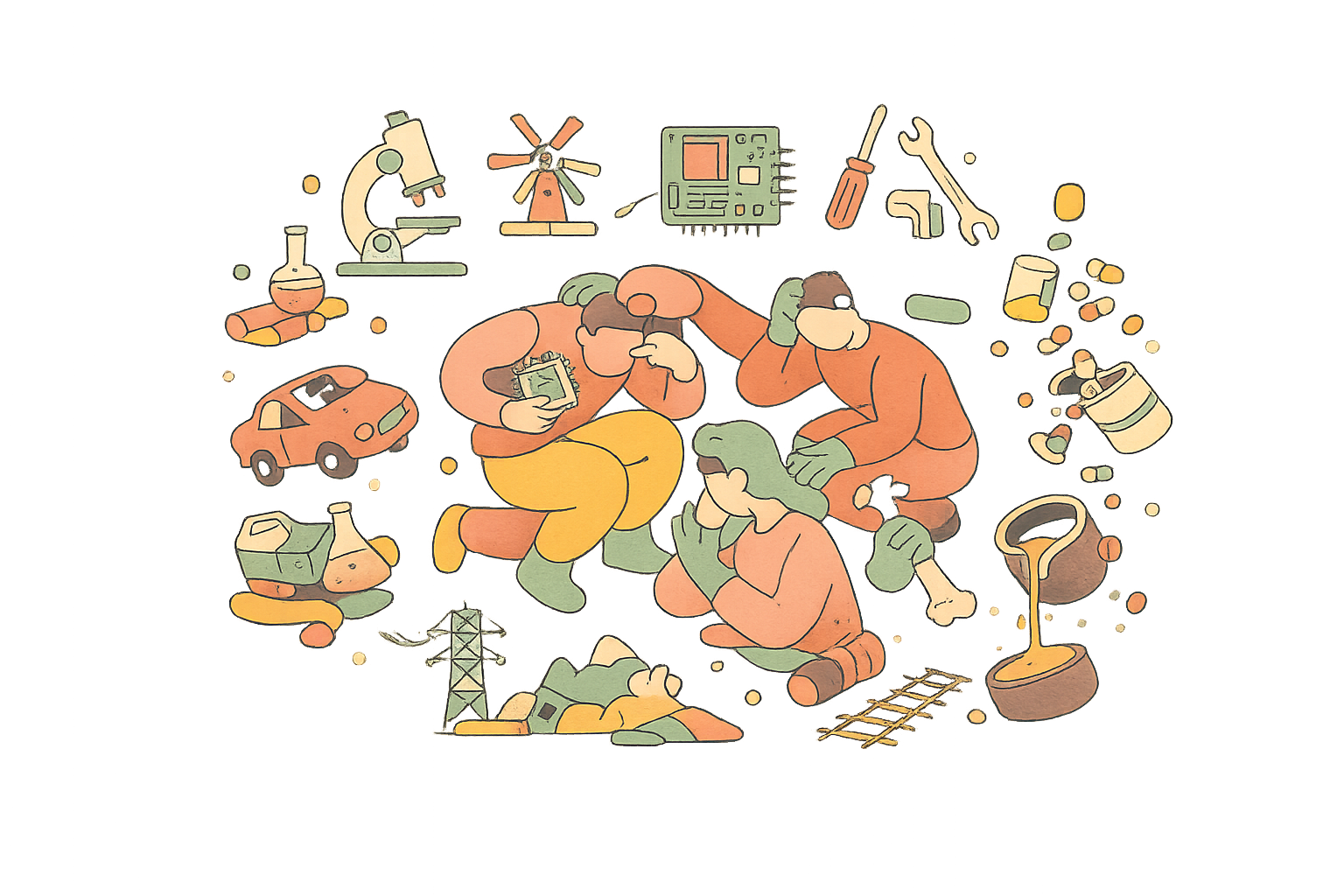
If all technology vanished tomorrow and only people remained, humanity would not return to ignorance. It would discover, brutally, that knowledge and capability are different things. The automobile engineer would still understand combustion, gearing and suspension. The surgeon would still know anatomy. The computer engineer would still grasp logic gates and operating systems. What would be missing is the great invisible inheritance that makes expertise usable: tools, power, materials, standards, supply chains, sanitation, laboratories, machine shops, mines, refineries, roads, ports and the countless intermediate devices that modern life quietly assumes.
Civilisation, in that sense, is less a library of ideas than a ladder of dependencies. Remove the ladder and even the brightest minds are left looking up.
This is why the fantasy of a rapid reboot is so misleading. A modern car is not a clever sketch waiting to happen; it is the final expression of an enormous industrial pyramid. Steel must be smelted to predictable tolerances. Rubber must be processed. Glass must be formed. Fuels and lubricants must be refined. Precision components must be machined so reliably that one part fits another without hand-forging and prayer. The history of industrialisation makes the point plainly: machine tools were the indispensable foundation of mass production and interchangeable parts. Before one can build cars at scale, one must first build the machines that build the parts that go into cars.
The same logic becomes harsher with electronics. A computer engineer without machinery is rather like a composer without instruments, paper or sound. The principles remain intact; the performance does not. Modern semiconductors depend on fabrication plants of extraordinary cleanliness, on chemicals of exceptional purity, on stable electricity and on vast quantities of ultrapure water. A chip is not a discrete invention. It is a compact summary of mining, chemistry, optics, materials science, logistics and precision engineering. To “make a computer” after technological disappearance would therefore mean rebuilding, in sequence, much of the industrial world.
Medicine offers a similar lesson. Doctors would still know how to diagnose infection, set bones and deliver babies. Their knowledge would save lives. Yet medicine without infrastructure quickly becomes pre-modern medicine. Antibiotics require industrial chemistry. Sterile surgery requires reliable water, sanitation, disinfectants, textiles, steel instruments and energy. Vaccines require cold chains and manufacturing capacity. Public health matters even more than clinical brilliance. The modern extension of life expectancy owed as much to clean water, sanitation and organised health systems as to heroic individual doctors. Remove those foundations and mortality rises long before medical knowledge itself is exhausted.
The first phase of reconstruction, then, would not resemble Silicon Valley. It would look more like the early 19th century, compressed into an age of memory. People would prioritise food, shelter, clean water, basic sanitation and simple energy. Agriculture would have to be stabilised. Workshops would replace factories. Blacksmiths, machinists, chemists, electricians and civil engineers would become the strategic class. Printing presses, hand tools, steam engines, rail, telegraphy and basic public-health systems would matter more than dreams of smartphones. Humanity would not restart at the frontier. It would restart at the base.
Still, the thought experiment is not wholly bleak. Knowledge would offer a colossal advantage over our ancestors. We already know that germs cause disease, that electricity can be generated, that steel can be mass-produced, that flight is possible, that radio works, that semiconductors exist. We would avoid centuries of false starts. Scientific method, engineering mathematics and accumulated theory would accelerate rediscovery. The route back would be shorter than the original climb.
Even so, shortening the route does not abolish the terrain. The modern world rests on layers so deep and interconnected that no expert, however gifted, can summon them alone. Human capital is essential, but it is never solitary. Expertise requires systems to express itself. The deeper truth of technological civilisation is therefore slightly humbling. We do not live because geniuses know things. We live as we do because millions of ordinary and specialised activities mesh into a functioning whole.
If all technology disappeared, civilisation would survive in minds first, then in habits, then in institutions, and only much later in machines. The struggle to rebuild would reveal what prosperity usually conceals: knowledge is powerful, but infrastructure is knowledge made durable.
Sources: World Health Organization; CDC; Encyclopaedia Britannica; U.S. Department of Energy.