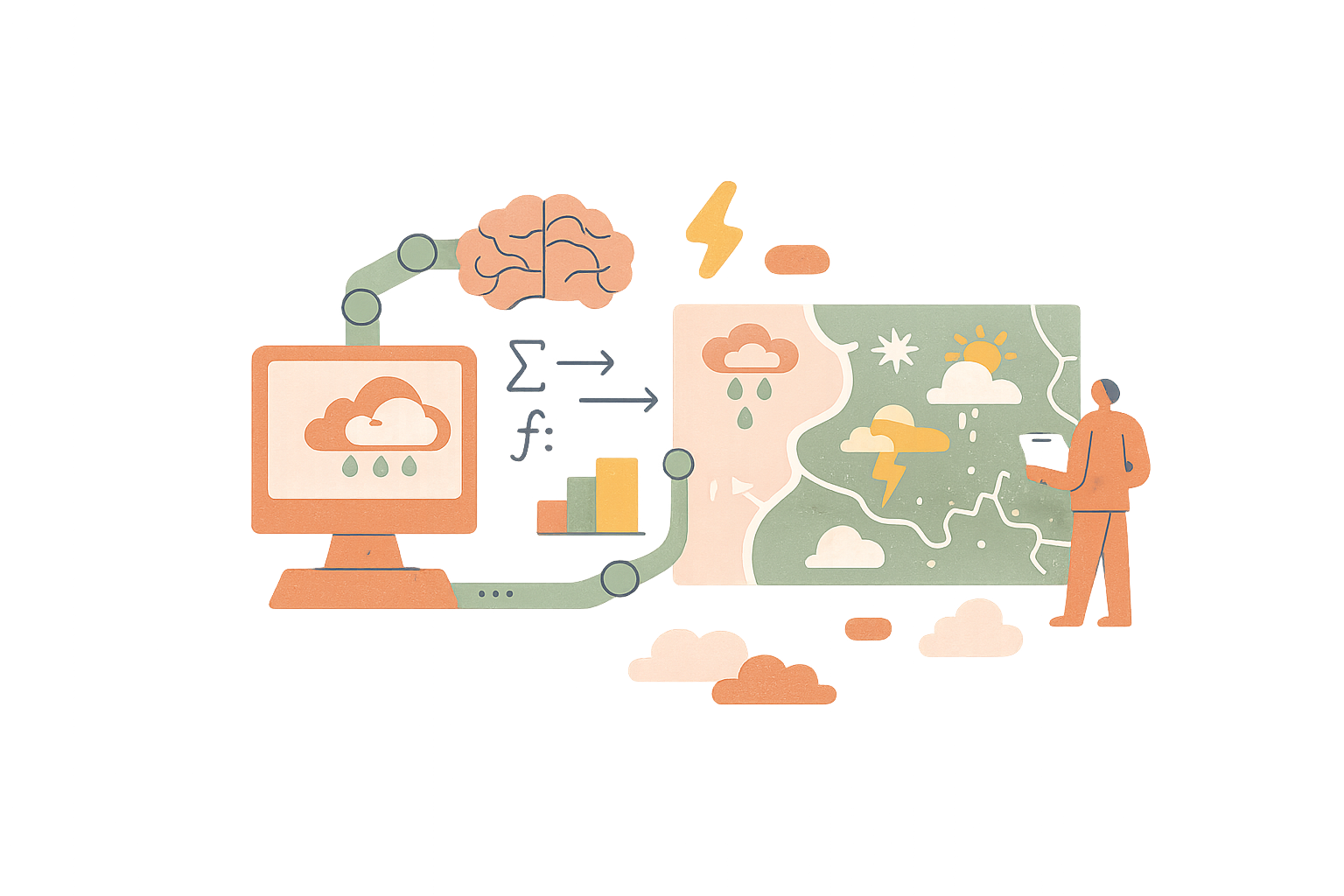
The most unsettling feature of the AI turn in science is not that the machines may be wrong. Science has always lived with error. It is that they may be right in ways that make the old ideal of understanding feel extravagantly expensive. Meteorology offers the clearest warning. For decades, weather prediction stood as a triumph of deductive science: begin with physical laws, assimilate observations, solve immense systems of equations, and generate a forecast. Yet the newest machine-learned forecasting systems have shown they can match or exceed the skill of traditional numerical models on many benchmarks, while producing results in a fraction of the time and with far lower computational cost. Europe’s leading weather centre now runs AI forecasts operationally alongside its physics-based system, and hybrid models are being designed precisely because the statistical systems are so strong at the largest scales.
That sounds like progress. It is progress. It is also a philosophical rupture.
Classical science earned authority by offering reasons as well as results. Newtonian mechanics did not merely predict the orbit; it supplied the conceptual architecture that made the orbit intelligible. A theory could be criticised, repaired, generalised. It invited deduction. The newer regime is more opportunistic. Feed enough data into a sufficiently powerful model and patterns emerge that no human being explicitly formulated. The machine does not derive a law in any recognisable scientific sense. It captures structure. It interpolates brilliantly across complexity. It often does so without yielding an account that scientists themselves would regard as explanation.
In weather forecasting this trade-off can be defended. Farmers, airlines and emergency planners care about accurate warnings more than metaphysical purity. A forecast that arrives in a minute and performs better than one that takes an hour has a claim on the future. The temptation, then, is to generalise the lesson: if prediction is what matters in practice, why continue paying the intellectual premium for mechanistic understanding? Why insist on elegant theories when probabilistic systems can produce decisions, classifications and forecasts of impressive reliability?
Because prediction and explanation are not interchangeable goods. A civilisation that gives up on explanation may retain competence while losing comprehension. Black-box systems can be exquisitely effective and still remain brittle, opaque and difficult to audit. They can absorb historical bias, fail strangely outside their training distribution, or conceal causal structure behind a haze of statistical success. Even where interpretability techniques improve trust, they often explain the model’s behaviour after the fact rather than disclose a genuine underlying law.
There is a darker possibility. Once institutions learn that probabilistic machinery delivers practical superiority, the incentives to train minds in deductive science begin to weaken. Why endure the arduous business of deriving first principles, constructing mechanistic models and mastering formal theory if the machine already forecasts better? The danger is not an outright abolition of traditional science. It is deskilling through neglect. Over time, scientific culture could drift from asking why the world works to asking only whether the output is accurate enough.
Quantum mechanics once humbled the deterministic aspirations of classical physics, but it still produced a formidable theoretical edifice. Today’s shift may be harsher: probability without comparable understanding, success without transparency, control without deep explanation. Science would survive, certainly. Laboratories would remain busy, predictions useful, applications lucrative. Yet something central could wither: the ambition to know, not merely to anticipate. If that ambition fades, the loss will arrive quietly, camouflaged as efficiency.
Citations: Nature; Google DeepMind publication on GraphCast; ECMWF operational announcements on AIFS and AIFS ENS; ECMWF technical evaluations and newsletters on AI versus physics-based forecasting; Nature Communications on explainable AI; reviews on interpretable machine learning in weather and climate prediction; philosophical literature on prediction and explanation in machine learning.