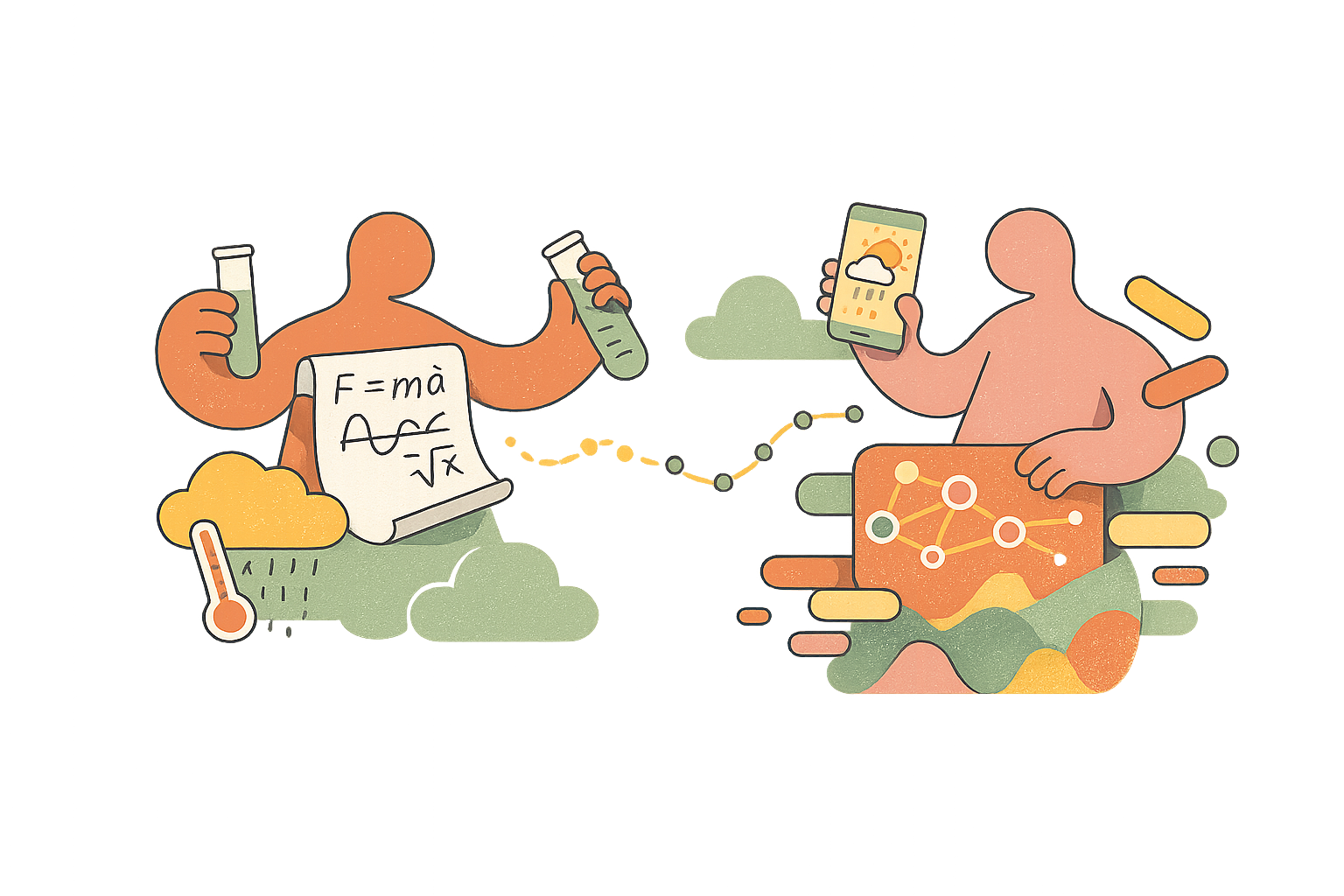
Science has long flattered itself with a particular image: a patient march from law to deduction, from principle to prediction. The grandeur of Newtonian mechanics lay not only in its accuracy, but in its style. One wrote down equations, specified initial conditions and let necessity do the rest. What now confronts that ideal is not a frontal refutation, but something more unsettling: a rival method that often predicts better while explaining less.
Weather forecasting offers the clearest emblem of the change. For decades, meteorology has been a triumph of explicit physics, numerical methods and brute-force computation. Yet machine-learning systems trained on vast archives of atmospheric data have begun to outperform established forecasting benchmarks on many tasks. Google DeepMind’s GraphCast showed striking gains over a leading conventional system across most verification targets. Microsoft’s Aurora and ECMWF’s own AI forecasting efforts have pushed further, with ECMWF making its Artificial Intelligence Forecasting System operational in February 2025 and later adding an ensemble version. These systems are faster by orders of magnitude and vastly cheaper to run. They do not solve the Navier-Stokes equations in the old-fashioned way; they infer likely futures from patterns embedded in data.
That practical success carries a philosophical charge. Classical science has prized explanation as much as prediction. A theory earned authority because it disclosed the structure of the world and allowed one to derive consequences from first principles. Probabilistic AI weakens that bond. It can deliver reliable forecasts without yielding much by way of intelligible mechanism. The old alliance between understanding and foresight begins to loosen. In some domains, one may know what will happen before one can say why.
This is not entirely unprecedented. Quantum mechanics already taught scientists to live with probability, amplitudes and irreducible uncertainty. Even so, it remained a highly formal science, rich in deduction and disciplined by theory. The new shift is different in texture. Here probability arrives through machine-trained correlation engines whose internal representations are often opaque even to their designers. That marks an epistemic migration from theories we can inspect to systems we can mainly validate.
The temptation is to declare victory for prediction and move on. That would be rash. Forecasting is not the whole of science. Science also compresses reality into transportable concepts, identifies causes, supports counterfactual reasoning and reveals when a result should fail. A model may tell us tomorrow’s temperature and still remain mute on climate dynamics, atmospheric chemistry or the behaviour of unprecedented extremes. Even in weather, physics-based systems retain advantages in some rare or extreme events, and leading institutions increasingly favour hybrids that combine learned models with physical constraints and observational assimilation.
The larger danger lies elsewhere: not that science disappears, but that its practitioners forget why deduction mattered. If probabilistic systems become so competent that the craft of theory-building atrophies, society may inherit immensely useful tools alongside a thinner culture of understanding. One can imagine a technically sophisticated civilisation that predicts brilliantly and explains poorly, rich in forecasts yet intellectually dependent on machines it cannot truly interrogate.
The wiser response is neither nostalgia nor surrender. Science is not defined by a single method. It has always changed its instruments. The task now is to preserve explanatory ambition inside a world increasingly governed by statistical success: to use probabilistic machines as extensions of inquiry rather than replacements for it. Otherwise, the quiet revolution under way in forecasting may become a broader settlement in which knowledge is measured by accuracy alone, and understanding is treated as an expensive luxury.
Sources: Nature; Science; European Centre for Medium-Range Weather Forecasts; World Meteorological Organization; Microsoft Research; Royal Society; Minds and Machines; Journal for General Philosophy of Science.