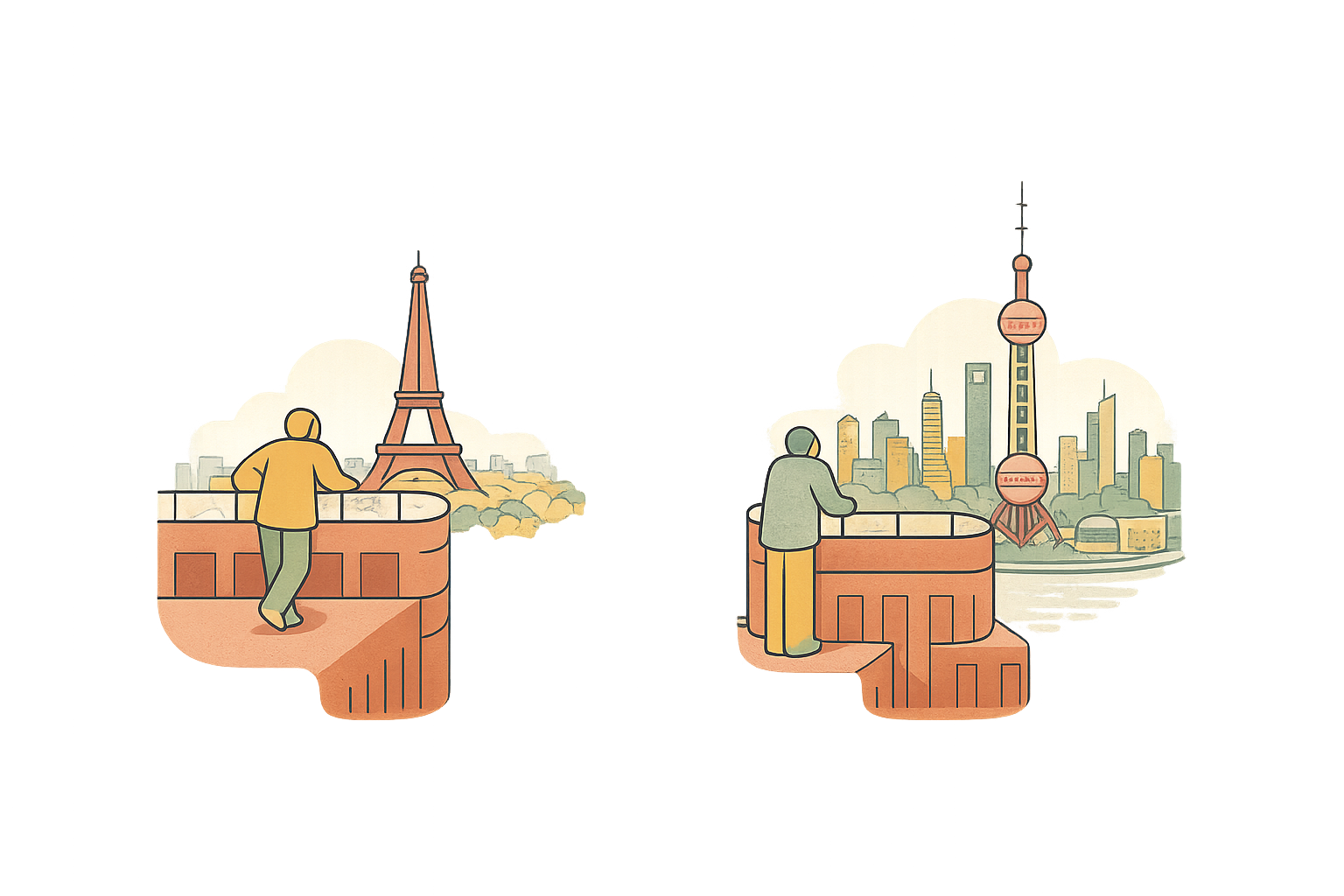
Every city has its stage set, and every tourist arrives with a mental shot list. In Shanghai, the desired image contains the Oriental Pearl Tower rising over the Huangpu like a piece of science-fiction theatre. In Paris, it contains the Eiffel Tower, improbably graceful despite a century of postcards, keyrings and cinematic overuse. The paradox begins the moment one buys a ticket to ascend them. Observation decks promise mastery through height, yet they remove from sight the very object that made the ascent desirable.
This is a small architectural joke with a larger point behind it. Landmarks operate in two ways. They are places to inhabit, and they are also images to possess. The trouble is that these two pleasures do not coincide. From the summit of the Eiffel Tower, one receives the official reward: a commanding panorama over Paris, a 360-degree survey of boulevards, monuments and the disciplined geometry of Haussmann’s city. From the Oriental Pearl Tower, one gets Shanghai spread out in neon confidence, the river, the Bund, the serried forest of Pudong. What one does not get is the complete picture that brought one there in the first place. The landmark has become the camera, and therefore cannot appear in the frame.
This helps explain why cities so often rely on second-tier buildings, and sometimes downright unloved ones, to provide their best views. Tour Montparnasse has long served precisely this function in Paris. It is one of the most reviled intrusions on the city’s skyline, a dark modern slab in a capital that prefers its verticality ornamental and distant. Yet its observation deck offers a singular compensation: Paris laid out before you with the Eiffel Tower standing exactly where it should, punctuating the horizon rather than disappearing beneath your feet. The building’s aesthetic vice becomes its practical virtue. An ugly tower can still perform a beautiful service if it keeps itself out of the composition.
The same logic applies beyond Paris. A city’s most satisfying viewpoint is rarely its most beloved monument. The perfect vantage is often slightly off-centre, located in a place with enough distance to restore proportion. Beauty, in urban terms, depends on exclusion as much as inclusion. To see a skyline properly, one must omit the platform on which one stands. This is true in art as well as tourism. Frames matter because they leave things out. A city seen whole always requires an invisible foreground.
There is, then, an irony at the heart of the observation deck: the higher one climbs into the symbol, the less one can see of the symbol as symbol. Monuments are best appreciated from elsewhere, at a respectful remove, where they can resume their role in the civic drama. The finest view of a famous tower is usually from another tower, another rooftop, another bank of the river. Cities, like people, are seldom understood from within their own self-regard. They need distance, contrast and an outside eye.
Perhaps that is the secret purpose of the architectural eyesore. It reminds us that admiration needs perspective. Even the ugliest building can be redeemed when it lends the city back its missing star.
Sources: Eiffel Tower official website; Tour Montparnasse official materials and history pages; Architectural Digest; CNN Style; official and travel reference materials on the Oriental Pearl Tower and Shanghai skyline.