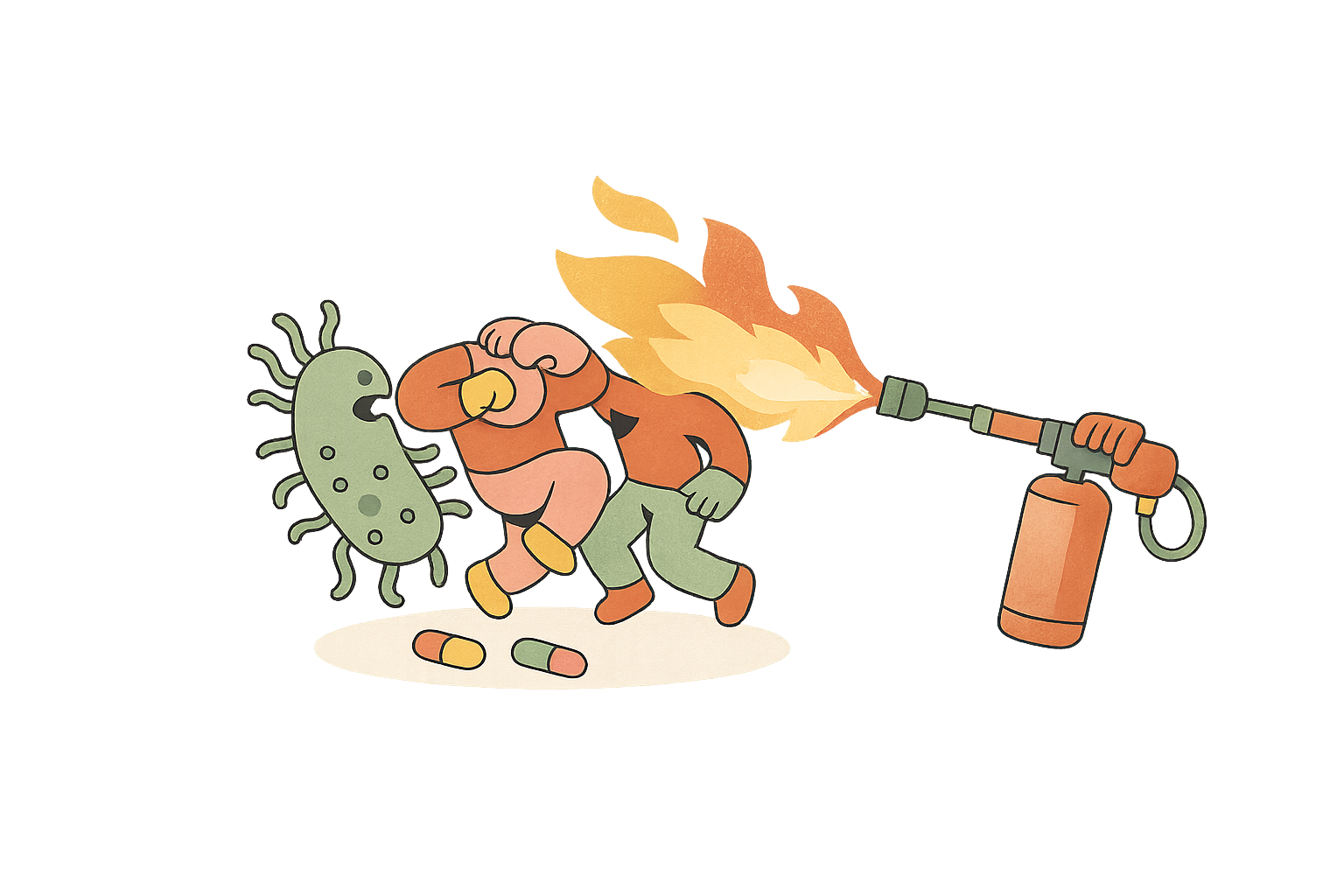
If the only criterion for an antibiotic were that it annihilates microbes, mankind could have dispensed with penicillin and embraced a flamethrower. Fire remains admirably broad-spectrum. It is swift, decisive and, so far as anyone can tell, has not prompted meaningful resistance in bacteria. Its one drawback lies in the fine print: the patient tends to object.
That, in miniature, is the whole drama of antibiotics. The miracle of these drugs has never been that they kill germs. Bleach does that. So does boiling water. The miracle is selective toxicity: the ability to wound the invader more than the host. Modern medicine rests on this narrow ledge. Caesarean sections, chemotherapy, joint replacements, organ transplants, even the routine treatment of pneumonia or an infected cut all depend on drugs that can clear an infection without finishing off the person first.
The trouble is that evolution has had a long time to study our methods. Antibiotic resistance is often described as a looming threat, though it has long since arrived. Resistant bacteria already contribute to millions of serious infections and were directly responsible for more than a million deaths globally in 2019, with a far larger number of deaths associated with drug-resistant infections overall. Surveillance data gathered by the World Health Organisation suggest resistance to common antibiotics is now widespread across much of the world. This is not a future inconvenience. It is a present corrosion of one of medicine’s central assumptions.
How did this happen? In part through sheer Darwinian predictability. Use an antibiotic often enough and the microbes that survive will be the ones best adapted to do so. Every unnecessary prescription, every patient who stops treatment early, every inappropriate dose, every casual use of antibiotics in livestock production offers bacteria another training exercise. Hospitals, with heavy antibiotic use and many vulnerable patients, can become proving grounds for especially formidable strains. Global travel then does the rest.
There is another difficulty, more economic than biological. Antibiotics are among the least attractive products for drug companies. A successful new antibiotic is precisely the sort of medicine doctors hope to use sparingly. It is held in reserve, prescribed briefly, and ideally rendered less necessary by better hygiene and vaccination. That may be excellent public health. It is not a glorious business model. The pipeline for new antibacterial drugs remains worryingly thin, and health agencies have repeatedly warned that innovation is failing to keep pace with need.
The future, therefore, contains two possibilities. In the grimmer one, resistance rises, routine surgery grows riskier, cancer treatment becomes more dangerous, and infections once dismissed as mundane recover their historic capacity to kill. Recent modelling has suggested tens of millions of deaths attributable to antimicrobial resistance could occur globally between now and 2050 if current trends persist, accompanied by heavy economic losses and strain on food systems. In the more sensible scenario, countries treat antibiotics as a shared resource rather than a consumer convenience: prescribe them better, monitor resistance more seriously, improve sanitation, expand vaccination, curb misuse in agriculture and reward the development of new drugs and rapid diagnostics.
Fire, then, remains an excellent antimicrobial in theory and an even better joke in practice. For actual medicine, civilisation requires something subtler: drugs potent enough to kill the microbe, prudent enough to preserve the patient, and a politics wise enough to preserve the drugs.
**Sources:** World Health Organisation fact sheets and 2025 surveillance reporting on antimicrobial resistance; CDC materials on antibiotic use and resistance; *The Lancet*/GRAM study on the global burden of bacterial antimicrobial resistance in 2019; World Bank and allied international modelling on the economic impact of antimicrobial resistance; recent global modelling reported ahead of the 2024 UN high-level discussions on AMR.