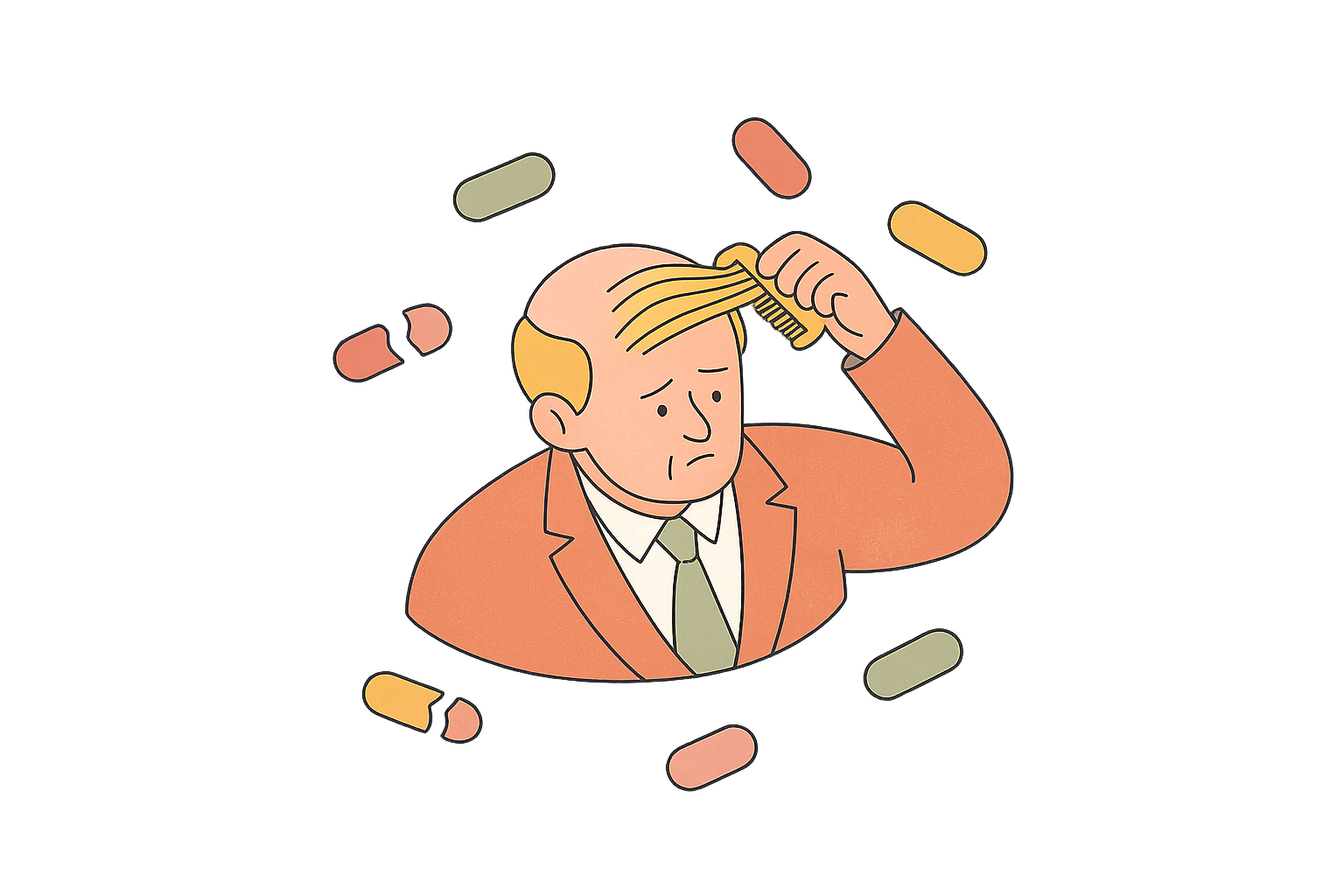
There is, in every city, a man whose hairstyle has become a public philosophy. At first glance the arrangement seems almost plausible: a disciplined sweep of surviving strands, marshalled across a widening frontier, holding back the obvious. But look twice and the comedy darkens. What began as camouflage has hardened into doctrine. The man is no longer styling his hair; he is defending a theory against reality.
I have come to think of this as the Combover Effect: the tendency of a strategy that once worked tolerably well to decay so gradually that nobody, least of all its owner, can say exactly when it ceased to work. That ambiguity is the source of its power. A failed scheme that collapses overnight can be abandoned with dignity. A failing scheme that deteriorates by degrees invites endless adjustment. One more inch. One more compromise. One more justification. By the time the thing is plainly absurd, it has become psychologically expensive to admit it.
Economists and political scientists have long described adjacent habits of mind. There is the sunk-cost fallacy: the refusal to quit because too much has already been invested. There is status-quo bias: the preference for what exists simply because it exists. And there is path dependence: the way institutions become trapped by decisions that once made sense but now merely reproduce themselves. The comb-over is all three in miniature. It is not just vanity. It is governance.
History is thick with such hairstyles. Empires often persist with administrative forms and strategic assumptions long after the world around them has changed, clinging to inherited grandeur because the alternatives feel like humiliation. The Byzantine Empire, for long stretches of its decline, remained attached to the prestige and habits of a universal empire even as its material base narrowed and its rivals multiplied. The tragedy was not simple blindness; it was the inability to recalibrate identity to circumstance.
Business offers a more modern spectacle. Kodak was not ignorant of digital photography; indeed, it helped pioneer it. Yet knowing that the future is arriving is not the same as reorganising oneself to survive it. Firms built on yesterday’s strengths tend to treat disruption as a temporary inconvenience rather than a verdict. They tweak, rebrand, refinance and reassure. The adjustments grow more frantic precisely because they are incremental. Each one postpones the reckoning while making it harder to undertake.
Politics is perhaps the purest arena of the Combover Effect. Governments keep policies on life support because withdrawing them would mean confessing that the past decade was a misreading. Parties repeat slogans emptied of explanatory force. Bureaucracies defend procedures whose original purpose has evaporated. The result is a peculiar kind of public theatre: everyone can see the bald patch, but the combing becomes more elaborate.
The deeper danger is not failure. Failure is common, and often useful. The danger is the moral and intellectual inertia that turns adaptation into self-betrayal. People do not cling to outdated arrangements because they are stupid. They cling because abandoning them threatens the story they tell about themselves. The comb-over survives not on the head, but in the ego.
That is why the Combover Effect matters beyond satire. It names a universal weakness: our tendency to mistake continuity for wisdom, adjustment for renewal, and embarrassment deferred for disaster avoided. The final indignity is that what was meant to conceal decline ends by advertising it. The world sees not the original lack, but the stubborn refusal to face it. And that, more than baldness, is what makes a man ridiculous.
**Sources:** Encyclopaedia Britannica on path dependence; Encyclopaedia Britannica on Eastman Kodak; Encyclopaedia Britannica on the Byzantine Empire and its decline; World Bank research on sunk-cost bias and decision-making barriers; OECD material on status-quo bias and related behavioural effects.