The lazy argument about artificial intelligence is that it will “take our jobs”. It may do that, at least for a while, and the transition will be ugly in places. But labour-market dislocation is a problem that modern states already know, in principle, how to manage: wage insurance, retraining, stronger unemployment protection, portable benefits, and tax-and-transfer systems that spread the gains from productivity more broadly. Even institutions as sober as the IMF now frame generative AI less as a simple employment apocalypse than as a distributional and policy challenge: who captures the gains, who bears the shocks, and whether governments are capable of cushioning the blow. If machines increasingly do jobs for people rather than instead of them, that is not the end of civilisation. It is, potentially, the start of a richer one.
The deeper danger lies elsewhere. It lies in the relationship between power and dependency.
For most of history, power has not been the property of isolated individuals. It has been social. A king required nobles, clerics, tax collectors and soldiers. An industrial baron needed managers, engineers, financiers and workers. A dictator needed generals, informants, bureaucrats and party loyalists. Even tyranny was collaborative. That was not because rulers were benevolent; it was because domination itself required a web of human intermediaries, each with interests of their own. However unjust the arrangement, power was constrained by the need to keep enough beneficiaries inside the tent. A ruler who ceased to serve the coalition that upheld him often discovered, sooner or later, that coups are also a form of accountability.
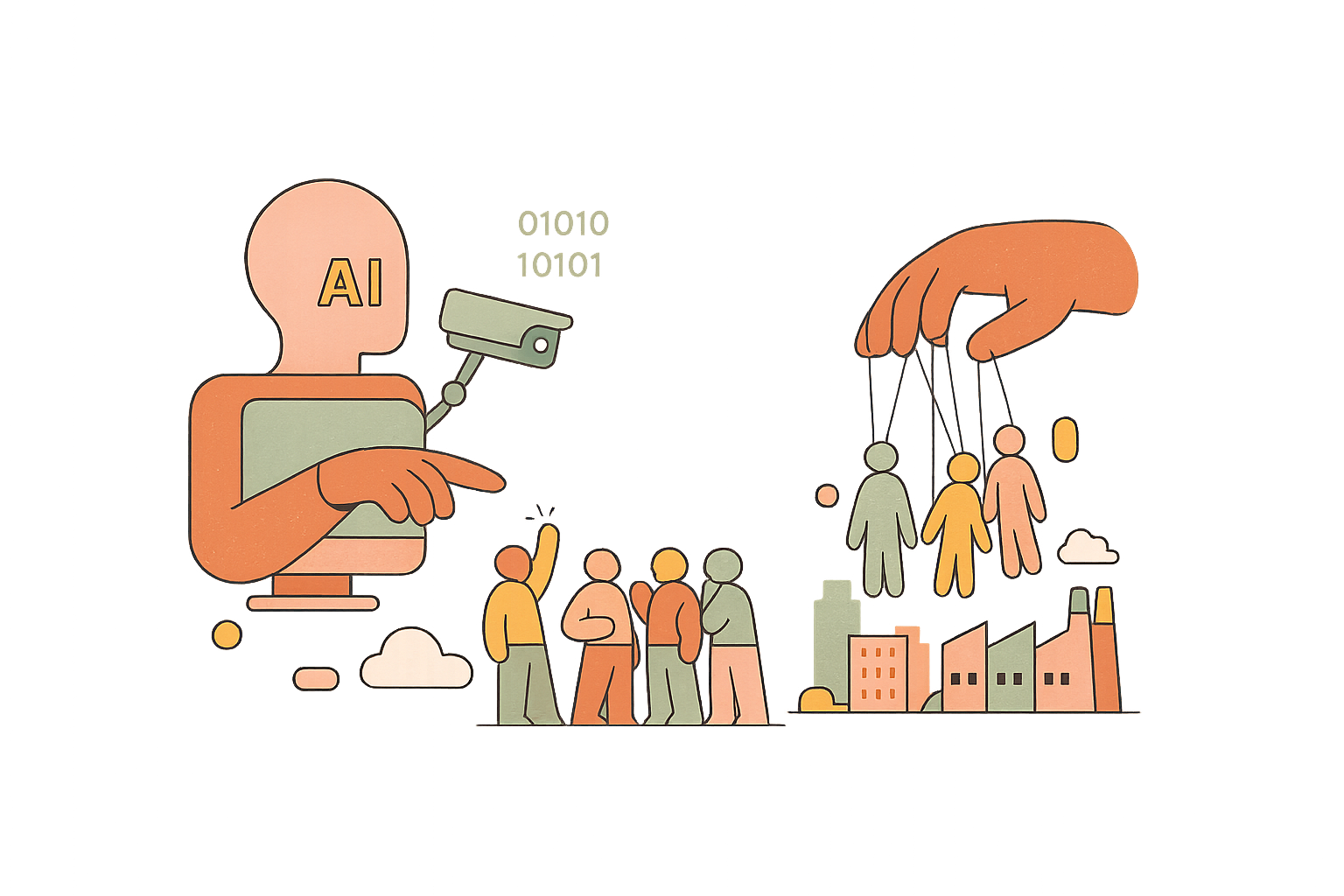
AI threatens to weaken that ancient rule. Not by making governments omnipotent overnight, but by reducing their dependence on human subordinates. A regime with sufficiently capable AI could automate surveillance, censorship, propaganda, targeting, logistics and coercive administration. It could monitor dissent at enormous scale, identify patterns no secret police ever could, and personalise manipulation with industrial efficiency. The chilling novelty is not merely that such systems might be repressive. It is that they could make repression less negotiable. Fewer soldiers to bribe, fewer officials to placate, fewer citizens whose cooperation must be won.
There is a related economic version of the same problem. If the commanding heights of AI are concentrated in a few firms that control chips, cloud infrastructure and foundation models, then power may pool not only in states, but in a narrow alliance of states and corporations. The classic liberal hope has been that pluralism emerges because power is dispersed across institutions, classes and interests. But if intelligence itself becomes a scalable utility, owned by a small number of actors and rented to everyone else, then political and economic dependency could tighten at once.
This is why the central question of the AI age is not employment, but constitutional order. How do societies preserve the old truth that power must remain relational, answerable and contingent on others? The answer will involve bans on the most dangerous uses, especially mass biometric surveillance and autonomous coercive systems; competition policy to prevent choke-points in compute and cloud; and democratic oversight strong enough to ensure that no ruler, ministry or company acquires a private machine bureaucracy beyond public scrutiny.
The optimists may yet be right that AI will enrich humanity. But prosperity without countervailing power is a brittle gift. The real test is whether we can build machines that serve human beings without allowing human beings, for the first time in history, to rule without needing one another.
Sources: IMF; OECD; European Commission; European Parliament; UK Competition and Markets Authority; FTC; Freedom House; UNESCO; OpenAI.