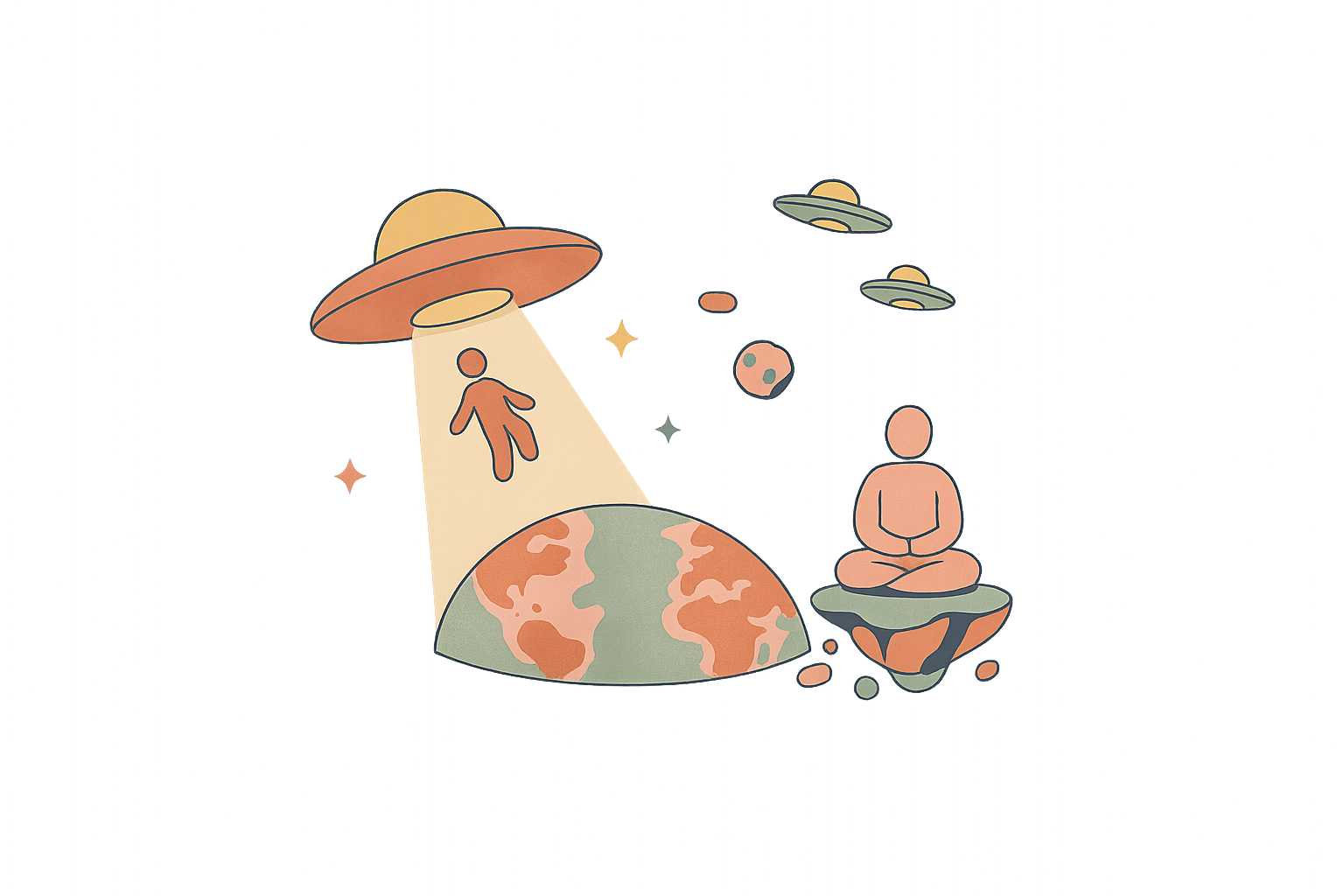
The alien invasion story is among humanity’s favourite narcissisms. We imagine that somewhere in the dark there lurks a more powerful civilisation, equipped with starships rather than caravels, ready to do to us what imperial Europe once did to much of the world. Hollywood supplies the familiar script: superior technology, resource extraction, native subjugation, the universe as colonial frontier. Even when the moral inversion is made explicit, as in *Avatar*, the grammar remains recognisably 19th-century. The aliens are not really alien. They are us, in costume.
That matters, because it reveals how provincial many supposedly cosmic anxieties are. The standard invasion plot assumes that progress culminates in bigger empires, greater appetites and more efficient domination. But that is a deeply historical, not universal, proposition. It reflects a particular phase of human development, one in which power meant territory, wealth meant physical extraction, and prestige meant expansion. To assume that any sufficiently advanced civilisation would behave likewise is to mistake one violent chapter of human history for a law of intelligence itself.
In practical terms, the case for extraterrestrial conquest is weaker still. A species capable of crossing interstellar distances would almost certainly have mastered energy, automation and materials science to a degree that makes planetary invasion economically absurd. Why plunder a defended biosphere for water, metals or hydrocarbons when the cosmos is full of unclaimed ice, rock and sunlight? Asteroids and uninhabited worlds would be easier quarries than a living planet with a troublesome native population. Even some advocates of large-scale space colonisation argue that the real prize of the universe is not any one planet, but the vast abundance of matter and energy beyond it.
More importantly, an advanced civilisation may no longer be driven by the crude compulsions that animate expansionist empires. Much of human striving arises from scarcity, status competition and the awkward architecture of our own brains. We labour because we must satisfy hunger, fear, vanity, libido and ambition. But a civilisation advanced enough to engineer minds as deftly as machines might also have learned to regulate desire itself. It could “hack” suffering, boredom or acquisitiveness far more effectively than it could occupy foreign continents. The highest technologies may not be star-drives but self-mastery.
This does not prove that advanced beings would be benevolent. Some thinkers have suggested darker possibilities: a universe of mutual suspicion, in which silence is rational and pre-emptive violence cannot be ruled out. Others imagine non-interference, a kind of cosmic zoology in which developing species are observed rather than contacted. Yet even these scenarios imply something different from the old imperial melodrama. They replace greed with strategy, conquest with caution.
And there lies the more interesting thought. If intelligence matures, perhaps it sheds the urge to dominate. Perhaps civilisational advancement consists not in projecting power ever farther outward, but in diminishing the inner compulsions that make domination seem worthwhile. A species truly at home in the universe may have no need of empire at all.
If so, the reason Earth has not been invaded is not that we are hidden, lucky or insignificant. It may simply be that conquest is the hobby of the half-civilised. Truly advanced beings, whether elsewhere or someday here, would have outgrown it.
**Sources:** SETI Institute material on advanced technological civilisation searches; Nick Bostrom on cosmic colonisation and the resources of space; discussions of the Fermi paradox, zoo hypothesis and dark-forest hypothesis in mainstream reference literature; Isaac Arthur’s analysis of the economics and physics of planetary conquest.