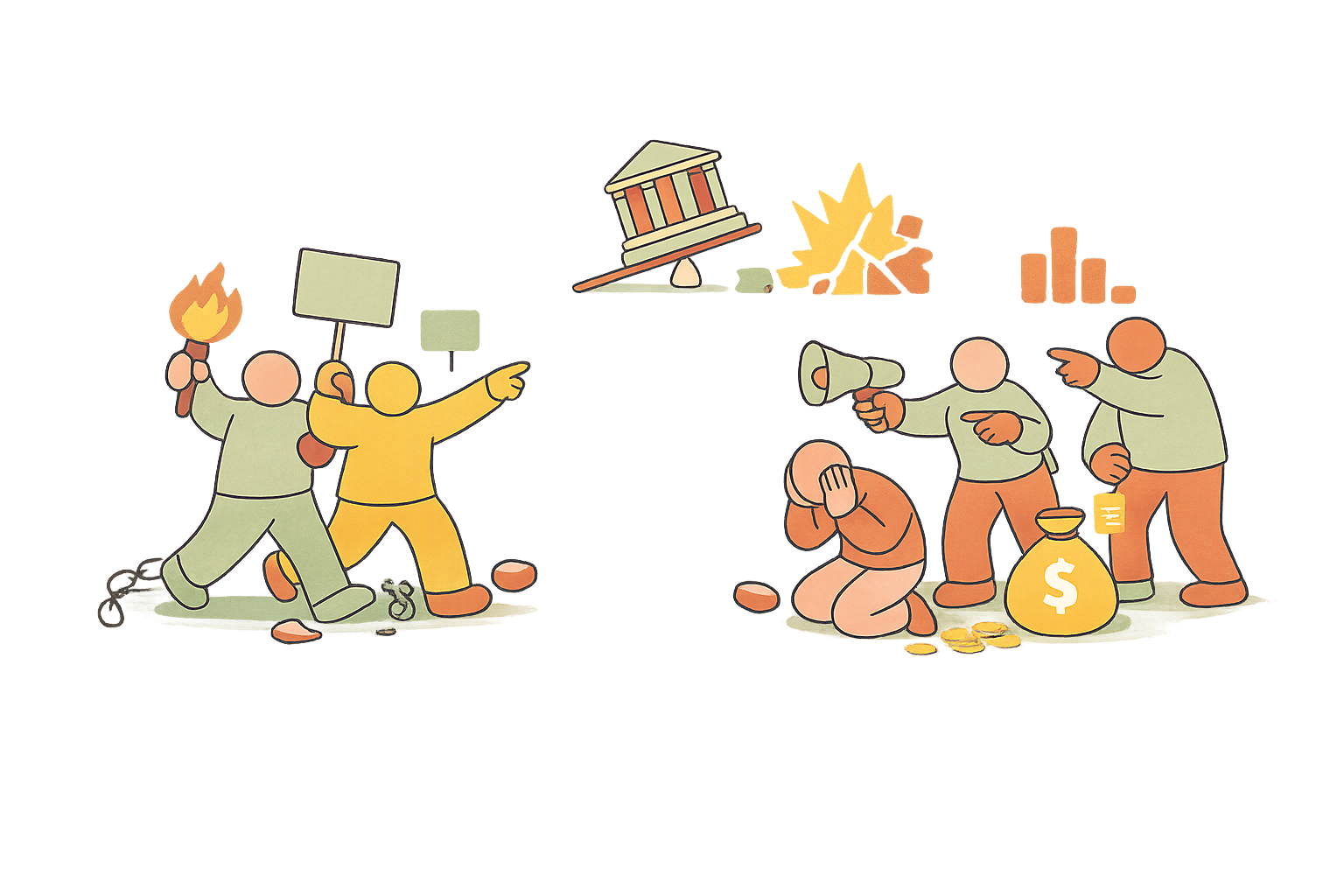
A durable political order requires more than police powers, patriotic ritual or the language of national destiny. It requires a social settlement that gives ordinary people a plausible reason to endure its inequalities. When that settlement frays, revolt does not always arrive wearing the colours of the left. It can just as easily reappear as a politics of resentment on the right, animated by betrayal, humiliation and the hunt for scapegoats.
Modern European history offers a useful lesson. Elites did not gradually extend the franchise, legalise unions, regulate workplaces and build social insurance merely from enlightenment or benevolence. They also did so because unreformed capitalism had become politically dangerous. A substantial body of historical scholarship argues that democratic concessions in the 19th and early 20th centuries were often responses to credible threats of unrest and revolution. Bismarck’s social insurance reforms in Germany, Britain’s pre-war welfare legislation and later the post-war welfare state all helped absorb social conflict into institutions rather than leaving it to the streets.
This is the often neglected genius of reformism. It did not abolish hierarchy. It domesticated it. The welfare state, progressive taxation, collective bargaining and mass enfranchisement made inequality more governable by making it less absolute. Social democracy was, among other things, a technology of stabilisation. It gave workers material improvements, political voice and some sense that the future might be better than the present. That matters enormously. A society can survive wide disparities of wealth more easily than it can survive the conviction that the game is permanently rigged and that improvement is impossible.
That conviction is spreading again. Across advanced economies, wealth has become more concentrated, social mobility has weakened and trust in public institutions has eroded. The OECD has repeatedly warned that high inequality curbs opportunity and undermines confidence in democratic life. Recent research also links economic insecurity, low institutional trust and status anxiety to support for populist parties. People who feel abandoned do not always develop a coherent class politics. Very often they develop a grievance politics. If no credible programme exists to confront concentrated wealth, anger is redirected toward immigrants, minorities, civil servants, universities or a vaguely defined “elite”.
This is why the contemporary far right can sound oddly revolutionary while remaining deeply hostile to egalitarian politics. Its energy comes from conditions similar to those that once nourished socialist upheaval: insecurity, humiliation, declining expectations and disbelief in established institutions. The object of blame has changed. The emotional structure has not. A politics that promises restoration, purification and revenge thrives where the social order appears indifferent to suffering.
Those who benefit most from the status quo should understand the danger with greater clarity than they often do. When inequality ceases to be socially tolerable, the eventual correction is rarely tidy. It may come through democratic reform, or through a destructive politics that preserves hierarchy while dismantling liberal institutions. The choice is not between perfect justice and business as usual. It is between timely adjustment and more volatile forms of reckoning.
If liberal democracies wish to preserve themselves, they need less sermonising about resilience and more evidence that the system can still deliver security, dignity and mobility. Stronger labour protections, more serious housing policy, broader access to healthcare and education, and tax systems that restrain extreme concentration are not acts of charity. They are acts of political maintenance. A happier public would indeed be a welcome consequence. The deeper point is plainer: a stable order must be made worth keeping.
Citations: OECD, *Society at a Glance 2024*; OECD, *Survey on Drivers of Trust in Public Institutions – 2024 Results*; Daron Acemoglu and James A. Robinson, “Why Did the West Extend the Franchise?”; *European Economic Review*, “Social Status Inequality and Populism” (2024); *European Journal of Political Research*, “How Does Income Inequality Affect Support for Populist Parties?” (2021).