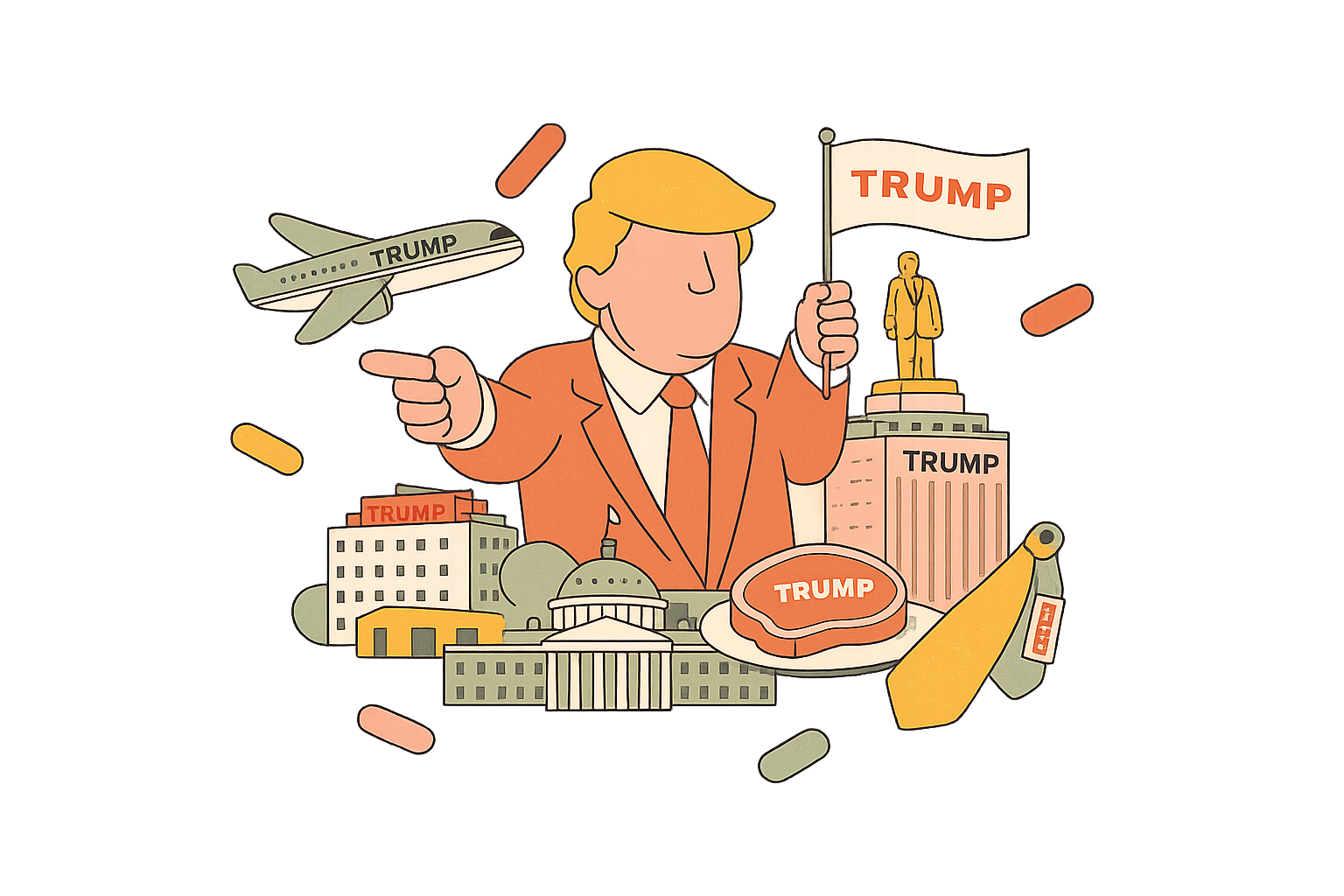
Donald Trump has always understood politics through the grammar of branding. Long before he returned to the White House, he treated the public sphere as a surface on which a name could be stamped, gilded and repeated until it acquired the force of inevitability. Hotels, steaks, ties, casinos, planes, universities: the instinct was never subtle. In office, that same instinct has increasingly pressed against a convention that democracies usually observe without needing to explain it—that public institutions are meant to outlast the vanity of the people who temporarily run them.
That convention matters because republican government depends on impersonality. Offices are supposed to be larger than office-holders; the state is not the monarch’s household, nor the president’s private franchise. When a leader insists on placing his name, likeness or signature at the centre of civic life, the gesture carries a meaning beyond decoration. It suggests that the nation’s common property is being converted into personal theatre.
Recent reporting has described the spread of Trump’s image and name across official settings in Washington during his second term, from outsized banners to branding exercises attached to public initiatives. Historians and scholars of authoritarian systems have noted how unusual this is in an American context, where the naming of monuments and institutions has generally been delayed until posterity has had time to judge. The point is not that every sign or portrait heralds tyranny. It is that such displays reveal a ruler’s conception of power: not as stewardship, but as self-inscription.
There is, too, a psychological pathos in all this. Trump’s extravagance often reads as confidence, yet it may be closer to its opposite. The compulsion to mark every surface with one’s identity can suggest an anxiety that one’s hold on memory is weaker than one’s hold on attention. Legacy, in that sense, becomes a problem of volume. If the name is large enough, if the portrait is frequent enough, if the emblem is unavoidable enough, perhaps history will confuse omnipresence with greatness.
Tolstoy understood the futility of that appetite. In “How Much Land Does a Man Need?”, the peasant Pahom keeps reaching for more, persuaded that one more acquisition will settle his restlessness. It never does. The story ends with a famously severe answer: all a man finally needs is enough ground to bury him. The moral is not merely that greed is ugly. It is that acquisitiveness contains its own punishment, because desire expands faster than possession. The man who cannot bear limits cannot be satisfied by accumulation.
Trump’s fixation on legacy seems vulnerable to the same law. Names attached by power can be removed by power, or mocked by the generations that follow. Grandeur imposed from above rarely converts into durable admiration. A legacy manufactured in real time often has a brittle quality, because it depends on coercing recognition before esteem has been earned. Posterity tends to be unkind to rulers who mistake advertisement for achievement.
That is why the public suffers from this style of politics even if one grants the inner insecurity that may animate it. Citizens are made to inhabit a political order bent toward the emotional needs of one man. Government becomes more theatrical and less serious. The common realm is shrunk to the dimensions of a personal obsession. There is something faintly pitiable in that hunger to leave one’s mark everywhere. There is also something corrosive in requiring everyone else to live inside it.
Citations: Reuters and AP reporting on Trump-branded products and official image-making; The Guardian, 21 February 2026 and 4 April 2026; The Washington Post, 20 February 2026 and 6 March 2026; Encyclopaedia Britannica on Tolstoy’s “How Much Land Does a Man Need?”