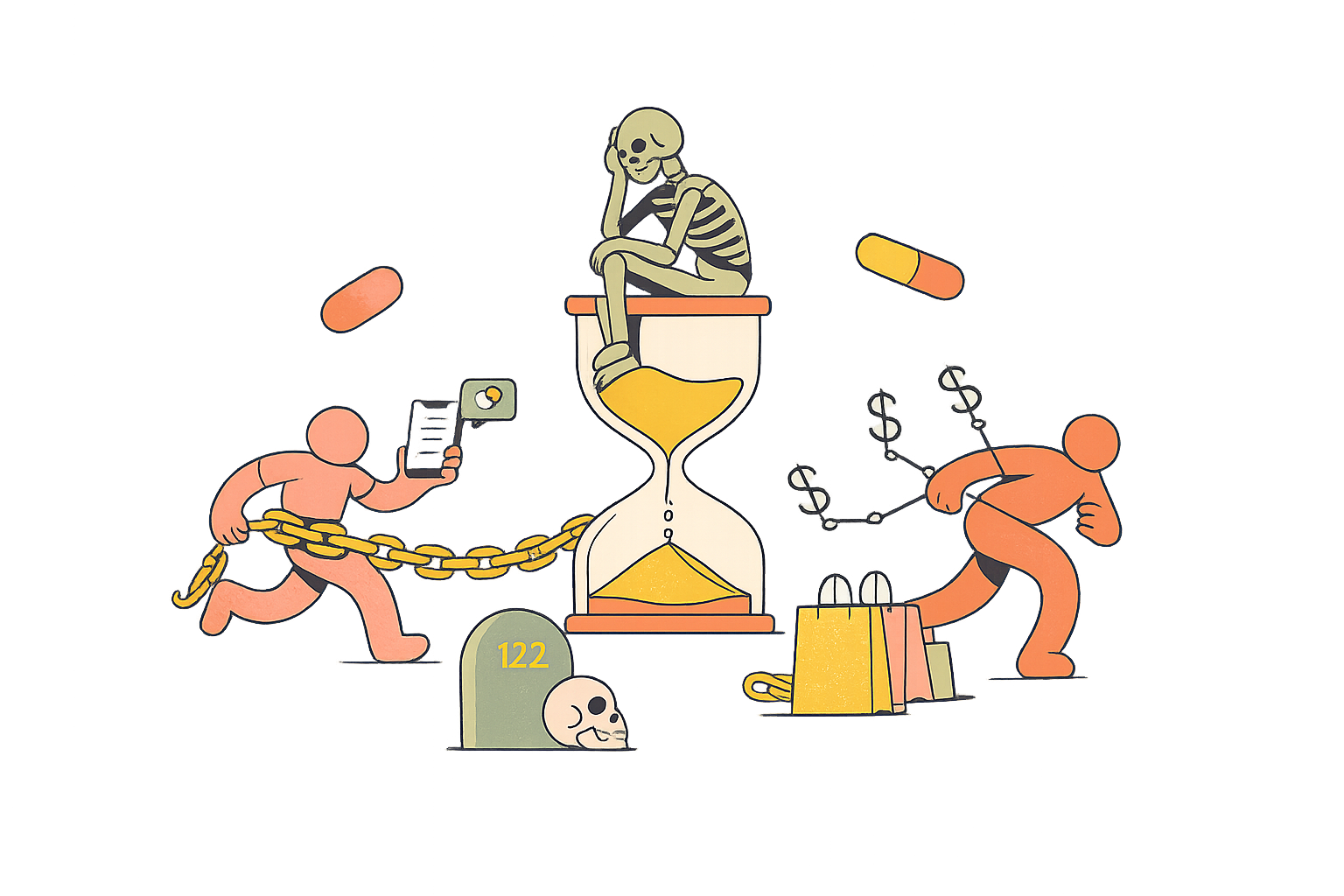
Whatever we become slaves of, it will only be for 100 or fewer years. The sentence sounds severe at first, yet its true force is clarifying rather than despairing. A human life is short by any serious measure. Global life expectancy is now a little over 73 years, and even the outer edge of documented longevity hardly escapes the low hundreds. Jeanne Calment, the oldest verified person on record, lived to 122. That remains an astonishment precisely because it is so rare. For almost all of us, every appetite, status anxiety, fixation and grievance is operating within a brief leasehold.
That ought to alter the scale of our attachments. Modern life has a talent for presenting temporary arrangements as if they were sovereign powers. Careers demand devotion in the language of vocation. Markets reward permanent availability. Digital platforms are engineered to convert attention into habit, and habit into dependence. Possessions quietly become custodians of the people who thought they owned them. Public opinion acquires the moral pressure once reserved for religion. In each case, a passing thing asks for lifelong obedience.
The point is not that ambition, work, love, discipline or even material comfort are disreputable. Civilisation depends on commitment. Families require sacrifice; institutions require duty; craft requires repetition. Yet there is a difference between serving a purpose and becoming mastered by it. The distinction matters because time is the only resource that cannot be replenished. Money can be recovered, reputation repaired, property replaced. Years spent in deference to vanity, resentment or trivial distraction do not return with interest.
This is not a new insight. The old traditions were often healthier on the subject than the contemporary world. Roman Stoics wrote as if mortality should be kept in plain view, not hidden behind euphemism or entertainment. Seneca’s reflections on the brevity of life were less a complaint about death than an indictment of drift. The medieval and early modern tradition of memento mori served a similar purpose. Remembering death was meant to discipline desire, reduce pomposity and expose the vulgarity of excessive materialism. Such traditions did not ask people to withdraw from the world. They asked them to see it in proportion.
That proportionality is what the phrase about slavery and a hundred years recovers. A tyrant, a fashion, a doctrine, a humiliation, a luxury, an addiction, even a triumph: none can hold legal title over a mortal creature for very long. This does not make suffering small. Ten years can be punishingly long from within. Poverty, coercion and dependency are real burdens, not philosophical toys. Still, the finitude of life places a limit around every regime of control. Even our captivities are temporary. Knowing that can stiffen resistance. It can also encourage mercy. The colleague consumed by prestige, the neighbour imprisoned by envy, the ideologue intoxicated by certainty: each is wagering a short existence on a poor master.
A sensible life may therefore begin with a simple audit: what currently commands me, and does it deserve the term? If the master is worthy, service can be honourable. If it is not, delay is expensive. We do not have eternity in which to misplace ourselves. We have, in all likelihood, some decades. That should be enough to choose our allegiances carefully, to treat idols with suspicion, and to remember that no earthly bondage is likely to outlast a century. In that fact there is a rebuke to vanity, and a modest kind of freedom.
Sources: World Health Organization; Guinness World Records; Encyclopaedia Britannica.