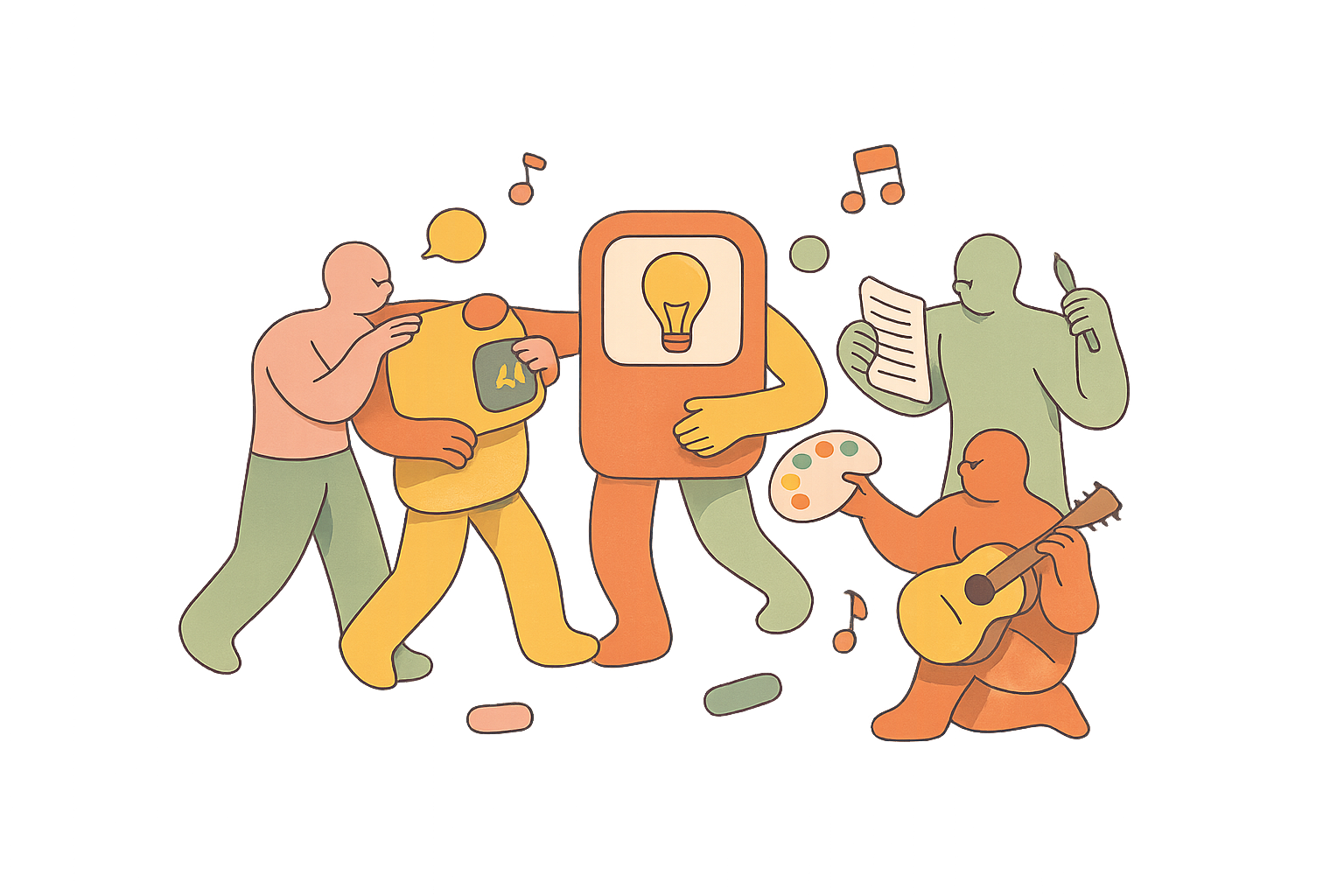
The mood around generative AI in the creative world is neither simple euphoria nor straightforward revolt. It is closer to a tense, unstable bargain. Artists, writers, musicians and filmmakers are using these tools in growing numbers, often because they are fast, cheap and increasingly hard to avoid. Yet the prevailing sentiment remains suspicious, defensive and morally unsettled. Creative industries are not rejecting the machine. They are trying to stop it from becoming the landlord.
That distinction matters. Much of the public conversation has been framed as a contest between romantics and technologists, as though artists object to efficiency on principle. The evidence suggests something more grounded. Creative workers do see utility in generative AI: for ideation, mock-ups, editing, translation, background production and administrative drudgery. Commercial design teams report gains in speed and workflow. Large creator surveys show that many professionals now incorporate AI into at least some part of their process. In practice, adoption has arrived faster than consensus.
Yet willingness to use a tool does not amount to trust in the system surrounding it. Across sectors, the strongest sentiment is conditional acceptance paired with deep resentment about how the technology has been built and who stands to benefit. Visual artists surveyed on generative image models have expressed concern about workforce impacts, ownership and profit extraction from their work. Writers have been even clearer. In an Authors Guild survey, only a tiny minority said it was acceptable for AI companies to use books without consent or compensation; overwhelming majorities demanded permission and payment. Many were open to licensing arrangements, though only under strict conditions involving control, attribution and continuing remuneration. That is not technophobia. It is a market demanding terms.
Music reveals the same pattern in harsher form. Songwriters and composers are anxious less because software can help produce a demo than because industrial-scale imitation threatens to flood the market, depress income and blur authorship. Recent surveys in music have found widespread fear that AI-generated tracks will compete with human work while being trained on it at the same time. Forecasts cited by cultural bodies and rights groups warn of substantial revenue losses for creators within a few years if current practices continue. For musicians, the grievance is economic, legal and existential all at once: their style risks becoming raw material for systems that owe them neither credit nor a cheque.
Film and television have served as the clearest early warning. Hollywood’s recent labour battles placed AI near the centre of the dispute, and for good reason. The Writers Guild of America secured some of the first meaningful contractual guardrails, establishing that AI cannot be treated as a writer and that its use must not erode credit, compensation or creative control. The strike offered a preview of the broader politics of generative AI. Creative workers are not merely contesting a gadget. They are contesting the terms under which human labour is made legible, replaceable and bargainable.
There is also a cultural objection that economics alone cannot capture. UNESCO and other international bodies have begun warning that AI is advancing faster than cultural governance, raising risks of homogenisation, platform dominance and erosion of cultural diversity. If generative systems are trained on the most abundant and marketable material, they may reinforce the familiar and flatten the marginal. That presents a problem larger than copyright. Culture depends on difference, minority expression, linguistic nuance and stubborn regional oddity. A machine optimised for plausible averages may produce abundance while weakening precisely those forms of originality that make culture worth having.
The creative world’s sentiment, then, can be read as a three-part verdict. First, generative AI is useful. Second, the present settlement is unfair. Third, the danger lies less in machine creativity than in corporate asymmetry. Creators fear a future in which their labour is harvested without consent, their styles are diluted into generic supply, and their negotiating power collapses under the rhetoric of inevitability.
That leaves room for a more constructive future, though only if law and policy catch up. Consent, compensation, transparency, provenance standards and enforceable labour protections would not smother innovation. They would civilise it. The central question is no longer whether generative AI belongs in the creative industries. It already does. The question is whether it will remain a servant of human imagination or become the mechanism by which imagination is stripped for parts.
Citations:
UNESCO, “A new expert report explores how AI is transforming culture”; UNESCO, “Re|Shaping Policies for Creativity 2026”; Authors Guild, “New Authors Guild AI Survey Reveals That Authors Overwhelmingly Want Consent and Compensation for Use of Their Works”; Lovato et al., “Foregrounding Artist Opinions: A Survey Study on Transparency, Ownership, and Fairness in AI Generative Art”; Brookings, “Hollywood writers went on strike to protect their livelihoods from generative AI”; OECD.AI incident summary on APRA AMCOS warning of revenue risk to Australian musicians; arXiv, “How Professional Visual Artists are Negotiating Generative AI in the Workplace”; Adobe, “Creative pros are leveraging Generative AI to do more and better work.”