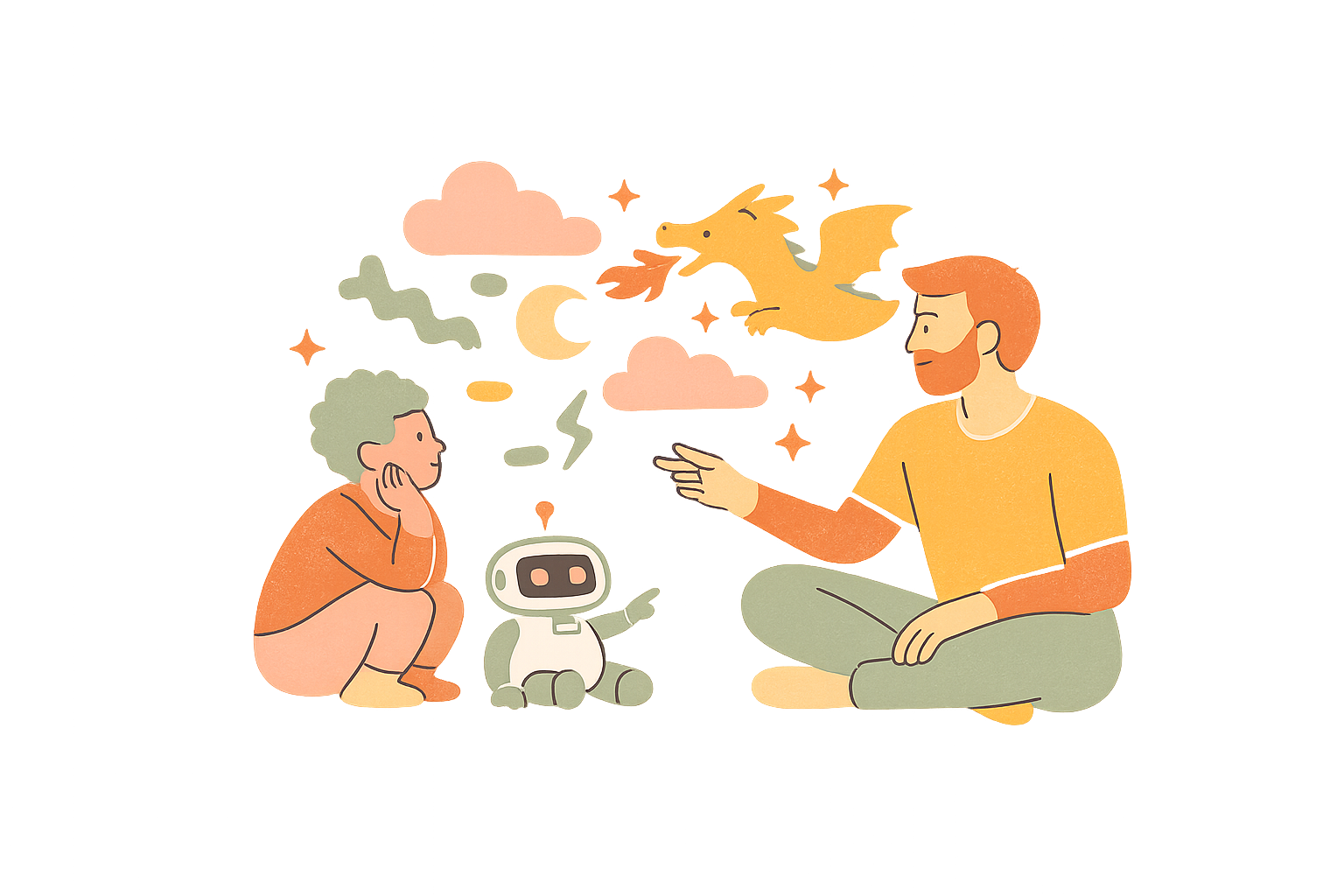
There was a time when a child’s most sophisticated bedtime technology was a parent with enough energy left to invent a dragon. Now the evening plea has changed with the age: “Dad, will you generate me a bedtime story?”
The sentence is comic, faintly absurd, and more revealing than it first appears. Children have always asked adults to conjure worlds on demand. The novelty lies in the verb. “Generate” belongs to the grammar of machines. It suggests infinite supply, personalisation at speed, stories assembled like playlists. A child can ask for a tale about a pirate astronaut who loves mango ice cream and fears thunderstorms, and some obliging system will deliver in seconds. The old scarcity of imagination has been replaced by abundance.
That sounds convenient, even magical. In some ways it is. Stories told at bedtime have long done far more than fill silence before sleep. Research on shared reading and language-based bedtime routines links them with stronger language development, literacy, emotional regulation and better sleep habits. Reading aloud before bed can also aid word learning, while regular story routines appear to support empathy, creativity and parent-child attachment. For exhausted parents, a tool that helps spin fresh narratives may seem less like cultural decline than domestic reinforcement: a helper in service of an ancient ritual.
Yet the important part of bedtime storytelling has never been the efficiency of production. It is the texture of attention. A bedtime story works because it arrives wrapped in human timing: the pause before the monster appears, the whispered improvisation when a child looks anxious, the digression that reflects the day’s scraped knee or playground triumph. The value lies partly in the story, and largely in the relationship around it. Studies of story time repeatedly find that interaction matters: turn-taking, questions, shared emotion, the small dance between adult and child. A perfect plot delivered without that exchange would miss the point.
This is where generative AI presents both promise and risk. Used sparingly, it can be a creative prompt for adults. A father stuck after the third retelling of the same rabbit adventure can borrow a premise, adapt it, embroider it, make it his own. Families already use technology in this way: supervised, intentional, and subordinate to the adults in the room. Some parents and researchers see value in introducing children to such tools carefully, so they learn that AI is neither oracle nor toy but instrument.
The danger begins when assistance becomes substitution. If the parent’s role shifts from storyteller to button-pressing intermediary, something intimate is thinned out. Bedtime is one of the last defensible frontiers against the industrial logic of frictionless content. Childhood already contains enough automated entertainment, enough screens, enough systems designed to anticipate desire before desire has fully formed. A child who asks for a generated story may be expressing wonder. An adult who answers only with generated output may be surrendering a small but meaningful duty.
There is also a subtler loss. Children do not merely consume stories; they learn how stories are made. They listen to hesitation, invention, revision and voice. They discover that imagination is a human act, imperfect and alive. An AI can produce endless narrative combinations. It cannot model fatherhood. It cannot show what it means to think lovingly under mild pressure, to create something inadequate but personal for someone you adore.
So the modern answer to that bedtime request should be neither panic nor surrender. Use the machine if one must, as one uses a torch to find the path. Then tell the story yourself. Change the ending. Add the family dog. Forget a detail. Invent a better one. Let the child interrupt. Let the tale wobble. In that wobble resides the point.
The future of bedtime may indeed involve generated stories. One hopes it will still involve parents who know that the deeper task is not content delivery. It is to make a child feel, in the dark, that another mind is present and theirs.
**Citations:** American Academy of Pediatrics via HealthyChildren; NIH/NICHD; Mindell et al., *Sleep Medicine Reviews*; Williams and Horst, *Developmental Science*; Dowdall et al., *Scientific Reports*; Sun et al., *Journal of Developmental & Behavioral Pediatrics*; Xu et al., *Journal of Children and Media*; *The Guardian* reporting on parents introducing children to generative AI.