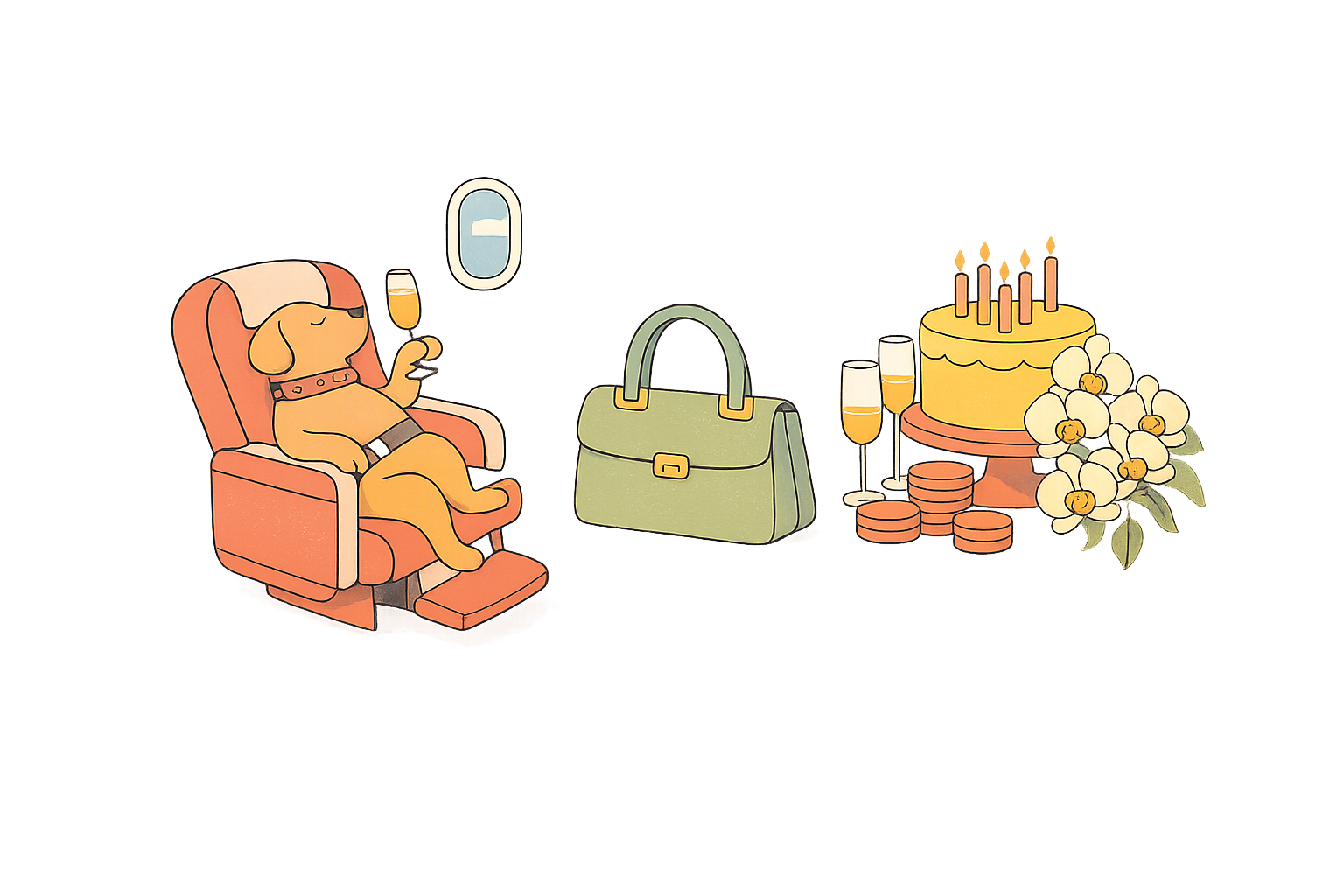
The vulgar sight of extravagance has a way of provoking moral clarity. A dog in first class, a handbag priced like a deposit on a flat, a birthday party with more orchids than guests: such spectacles look like evidence of a society that has lost its mind. In one sense, they are. They reveal a level of wealth concentration so extreme that convenience has become theatre. Yet if one is choosing among bad options, this may be the least damaging one. Better the plutocrat who burns money on absurd consumption than the one who quietly compounds it into dynastic power.
This is not a defence of inequality. The underlying scandal remains the same: too much wealth sits in too few hands. Across OECD countries, household wealth is heavily concentrated at the top, with financial assets even more concentrated than housing. The richest households save more, hold the kinds of assets that rise fastest in value, and are best placed to pass those gains on. Wealth begets more wealth with a mechanical efficiency that wages rarely match. Once fortunes are parked in businesses, trusts, property portfolios and financial instruments, they do not merely endure; they acquire political influence, cultural deference and legal protection.
That is why frivolous spending has an oddly redistributive quality, however faint. Money spent on nonsense still moves. The dog’s first-class seat pays airline staff, ground handlers, caterers, cleaners, fuel suppliers and the many firms layered behind a luxury service. The jewels, the yacht refit, the extravagant wedding and the impossible kitchen renovation all create demand for labour. One may object, reasonably, that these are often low-status service jobs performed for the vanity of the rich. Even so, wages are wages. A pound spent on a ludicrous indulgence at least leaves the vault and enters the economy.
By contrast, wealth that is merely preserved tends to harden social hierarchies. Financial wealth is especially concentrated among the top of the distribution, and inherited wealth is clustered there too. In many countries, most housing wealth transfers occur through inheritance, and inherited owner-occupied housing wealth is disproportionately held by the already wealthy. The consequence is familiar: children of affluence begin adult life with cushions, assets and options, while everyone else begins with rent. A fortune that is invested may finance productive enterprise, of course. It may also sit in land, chase tax advantages, inflate asset prices and thicken the walls around privilege.
There is, then, a useful distinction between spending that dissipates concentrated wealth and accumulation that entrenches it. Economists have long observed that the wealthy do consume out of wealth, even if only a small share of each additional dollar of assets is turned into spending. That modest leakage matters. Once fortunes grow to immense scale, even a low propensity to consume can translate into very large outlays. Lavish consumption is hardly a social programme, and nobody should mistake luxury demand for justice. But compared with indefinite hoarding, it has one virtue: it prevents every surplus pound from returning to the asset machine.
None of this absolves governments of responsibility. A healthy society should not rely on billionaire foolishness as an instrument of circulation. If wealth is excessively concentrated, the proper remedies remain taxation, stronger inheritance rules, broader asset ownership, abundant housing and a labour market that gives ordinary people bargaining power. Inheritance and estate taxes exist in many advanced economies precisely because wealth transfers can undermine equality of opportunity. Where such taxes are weak or porous, family fortune becomes less a private matter than a public architecture.
So by all means recoil at the dog in first class. It is grotesque. It advertises a lopsided economy and a warped moral order. Yet there is a difference between wealth that is squandered and wealth that is embalmed. The former is ridiculous. The latter is dangerous. If society must tolerate riches, it should prefer the kind that leaks.
Citations: OECD, *Inheritance Taxation in OECD Countries*; OECD, *Housing Taxation in OECD Countries*; OECD, *To Have and Have Not: How to Bridge the Gap in Opportunities*; OECD, *Employment Outlook 2025*; IMF, *Finance & Development*, “The Rich and the Great Recession”; McKinsey, *The State of Luxury in 2025*.