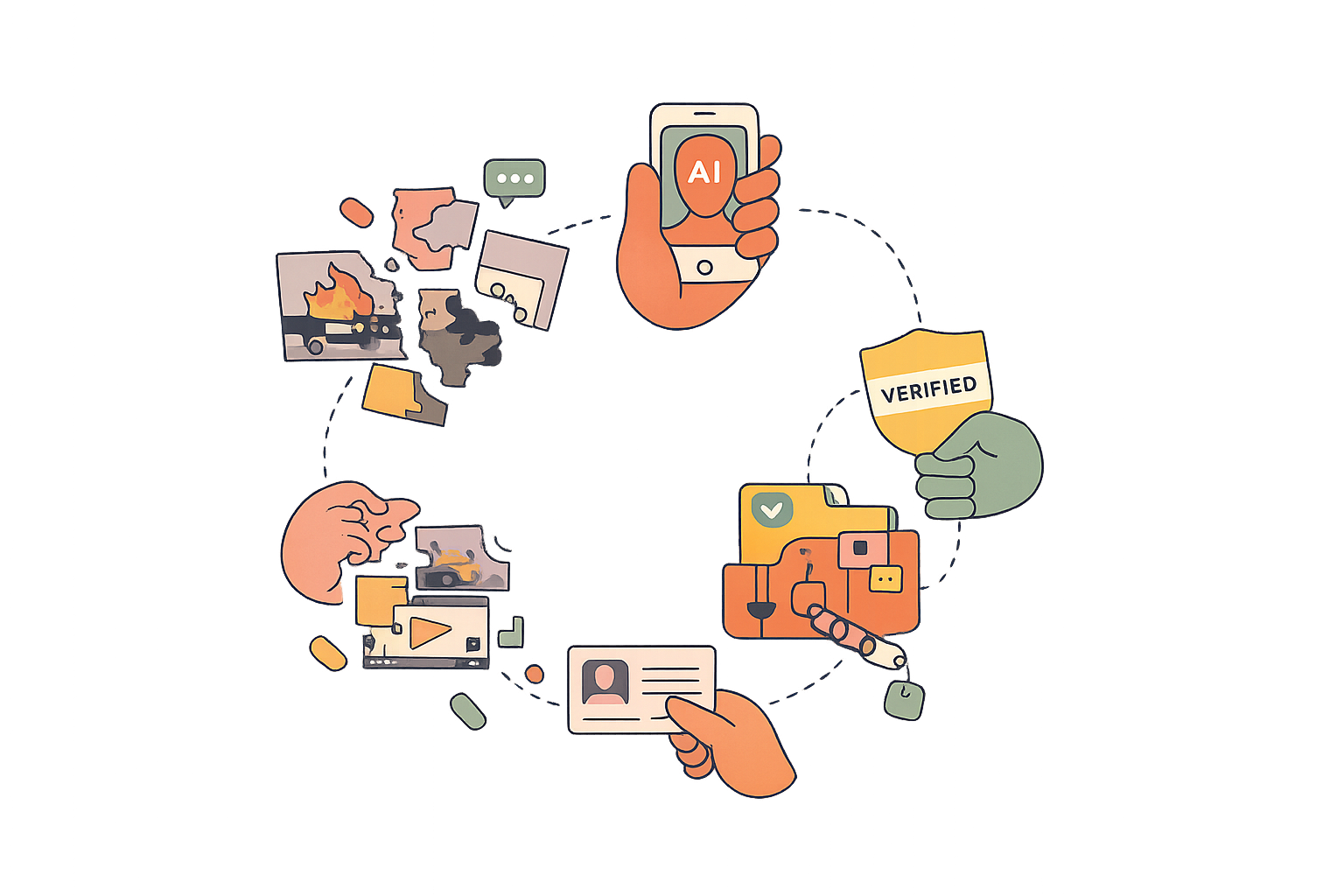
The supposed “epistemic collapse” of the internet has been narrated as if civilisation were losing its grip on reality. That diagnosis flatters the recent past. What is ending is not a golden age of democratic truth, but a brief and peculiar interlude in which the public confused abundance with reliability. For roughly two decades, the digital commons ran on a hidden subsidy: the belief that a photograph, a clip, a screenshot or a livestream possessed an almost automatic claim on the real. Smartphones multiplied witnesses, social platforms dissolved distribution costs, and an entire culture grew accustomed to treating raw digital artefacts as self-authenticating. The file seemed to speak for itself.
It never really did. The so-called age of citizen truth rested on contingent technical facts: that fakery remained expensive, coordination difficult and deception usually clumsy. Social media’s great epistemic promise was built on the weakness of its tools, not the strength of its philosophy. Once generative AI made plausible fabrication cheap, scalable and instantaneous, the old bargain expired. A video no longer proves presence; an image no longer guarantees an event; a voice recording no longer secures identity. The system has not collapsed. It has merely lost its innocence.
Seen in that light, the present anxiety looks less like a plunge into post-truth than a reversion to older and sterner habits of verification. Before the internet’s great levelling, the public relied on institutions because institutions were among the few actors capable of assembling evidence at scale. Newsrooms had bureaus, editors, legal departments, standards desks and reputations that could be damaged. Their authority was often imperfect and sometimes abused, but it served an indispensable function: it concentrated responsibility. A masthead meant that somebody could be asked how this was known, who checked it, and what would happen if it proved false.
That logic is returning. In a world saturated with synthetic media, trust is shifting from appearance to provenance. The central question is becoming less “What does this show?” than “Where did this come from, and who stands behind it?” This is why technical efforts such as C2PA and Content Credentials matter. Their promise lies in attaching tamper-evident, cryptographically signed information about origin and edits to digital content, creating something closer to a chain of custody than a mere file. Adoption remains incomplete and the standard is no magic talisman; even its own architects warn that unsigned content should not automatically be treated as suspect. Yet the direction of travel is unmistakable. Broad industry uptake is under way, C2PA has expanded rapidly, and broadcasters such as France Télévisions have begun integrating the standard into news workflows.
The broader cultural consequence is a flight to quality. Audiences, battered by misinformation and imitation, are rediscovering the value of recognised brands and explicit verification. Professional journalism gains from this environment for a reason more profound than style or speed. Reporters do not simply produce content. They assume ethical and legal liability for it. They can be challenged, contradicted, sanctioned, sued, fired or disgraced. Their institutions can publish corrections and defend methods. That burden of accountability is not an incidental feature of truth-telling; it is one of its conditions.
Generative AI therefore does not abolish the reporter. It raises the market price of being physically present, methodologically transparent and institutionally answerable. The old slogan that “everyone is a journalist” now sounds less democratic than naive. Everyone may publish. Far fewer can verify. Fewer still can do so under standards that survive political pressure, legal scrutiny and technological fraud.
There is danger here, certainly. A provenance-heavy world could privilege large institutions and marginalise independent witnesses, especially in places where official narratives are themselves untrustworthy. The “liar’s dividend” remains real: powerful actors can exploit public uncertainty to dismiss genuine evidence as fabricated. The answer, however, is not nostalgia for the anarchic internet of 2012. It is to build stronger methods for authentication while preserving pluralism in who gets to bear witness.
The deeper truth is almost conservative. Reality has always required custodians. The digital age briefly pretended otherwise. That illusion is over. What comes next looks less like collapse than professional restoration: a harsher, more expensive and more honest information order in which the masthead matters, the byline matters, and the hardest currency in journalism is once again the human being who was there.
Sources: C2PA specifications and explainer; C2PA conformance and FAQ materials; France Télévisions and European Broadcasting Union reports on C2PA implementation; Brookings analysis on the “liar’s dividend”.