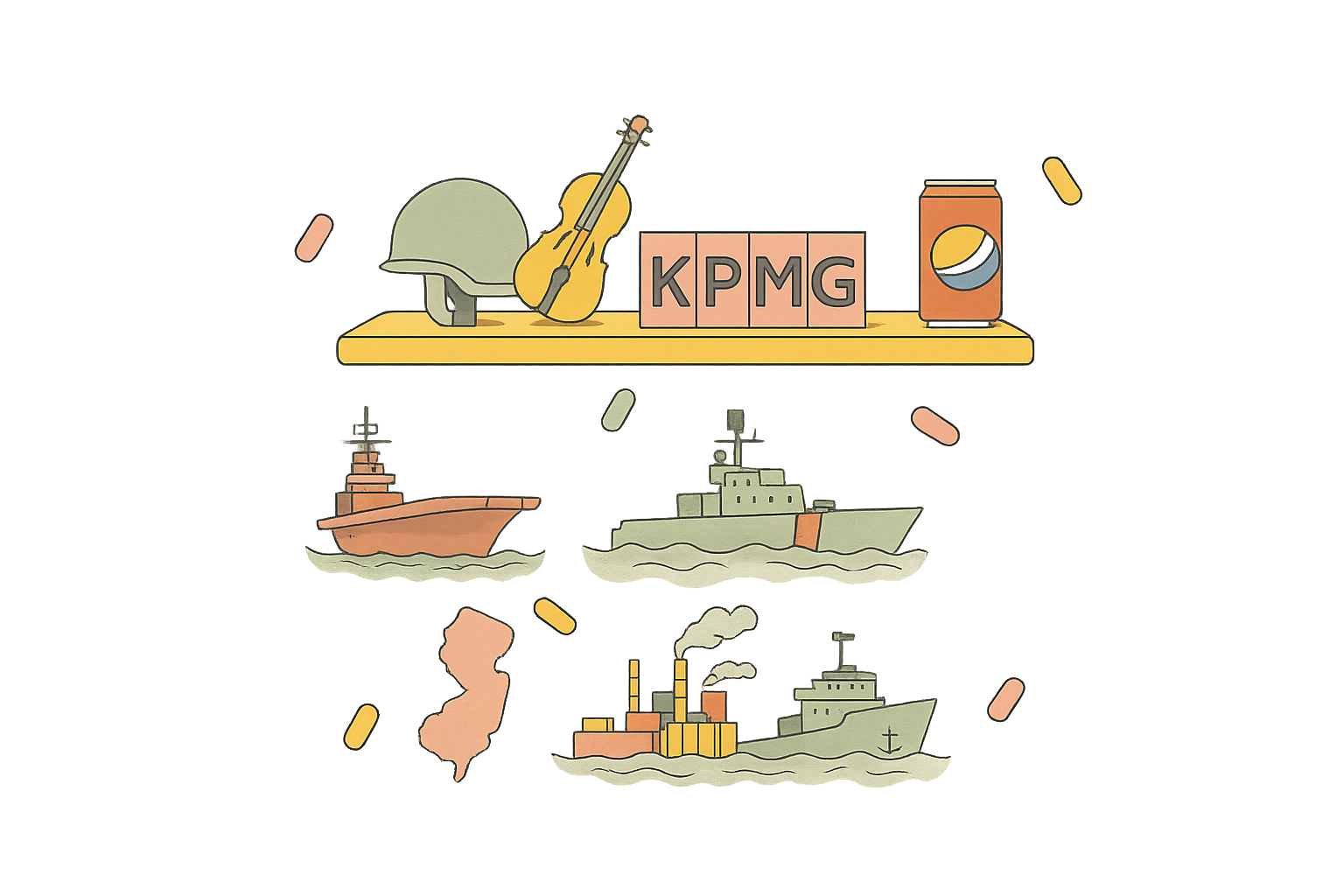
Every society keeps a shelf of respectable punchlines. A few names are placed on it and, once there, they seem to stay there for decades: viola players in orchestras, the Coast Guard among military branches, New Jersey in the American imagination, KPMG in corporate life, Pepsi in the cola wars. None of these are absurd in themselves. Each is perfectly functional, often excellent, occasionally indispensable. Yet all have acquired the comic aura of the designated runner-up, the institution fated to be smirked at.
This habit is older than social media and more revealing than it looks. Mockery of the viola dates back centuries, to a time when the instrument’s part in the orchestra was often less glamorous and its players were treated as second-tier musicians. The joke survived long after the reality changed. Modern violists are highly trained, the instrument has a rich repertory, and orchestras would sound impoverished without its dark middle voice. The stereotype endures because jokes fossilise social hierarchies. Once a group is marked as the “safe” target, the line reproduces itself long after its factual basis has crumbled.
The same mechanism works outside music. The United States Coast Guard is, by law, a branch of the armed forces. It performs military, law-enforcement and search-and-rescue missions, often in conditions that make deskbound patriots look faintly ornamental. Yet it attracts the sort of teasing reserved for institutions that seem adjacent to greatness rather than central to it. Its problem is partly aesthetic. Aircraft carriers and fighter jets are the stuff of blockbuster cinema; cutters, interdictions and maritime regulation are more procedural. Competence without pageantry rarely wins the culture war.
Places suffer in much the same way. New Jersey has long functioned as America’s convenient regional punchbag, helped by the industrial stretch visible from the turnpike, then amplified by television shorthand from The Sopranos to Jersey Shore. This has very little to do with the state’s actual complexity and everything to do with narrative efficiency. Crowded societies simplify geography into caricature. One place becomes chic, another serious, a third ridiculous. In Hong Kong, Kowloon has sometimes played a similar role in the city’s own internal map of snobbery: not accurately, but memorably.
Brands and firms invite the same treatment. KPMG occupies that unhappy corporate zone of being large, prestigious and faintly unloved. Its name evokes PowerPoint, audit failures and the humourless bureaucracy of modern capitalism. Pepsi, meanwhile, suffers from being globally recognisable while also being cast as Coca-Cola’s understudy. That is enough to turn a hugely successful product into a cultural shrug. The market position scarcely matters. Symbolically, second place is comic territory.
Why is this so pleasurable? Because ridicule is social glue. Shared derision creates quick solidarity among those doing the deriding. It offers a low-cost way to signal belonging: I know the joke, therefore I am in on the tribe’s codes. Psychologists describe humour as working best when a violation feels benign. These targets are ideal because they are familiar, substantial and resilient enough to absorb the blow. Few people fear that Pepsi or New Jersey will be destroyed by another joke.
There is, though, a small moral lesson in all this. Societies need their harmless clichés, yet they should occasionally inspect them. The butt of the joke is often simply the thing caught in the middle: neither elite enough to command awe nor marginal enough to command sympathy. Ridicule, in that sense, is a map of status anxiety. We laugh at what reminds us how desperately human beings rank the world, even when the ranking is absurd.
Citations: Legal Information Institute, U.S. Code Title 14; research on viola jokes and musicians’ folklore; reporting on KPMG and the Carillion audit penalties in The Guardian and Bloomberg; cultural commentary on New Jersey in The New Yorker, Salon and New Jersey Monthly; research on humour, social distance and status in SAGE and related psychology literature.