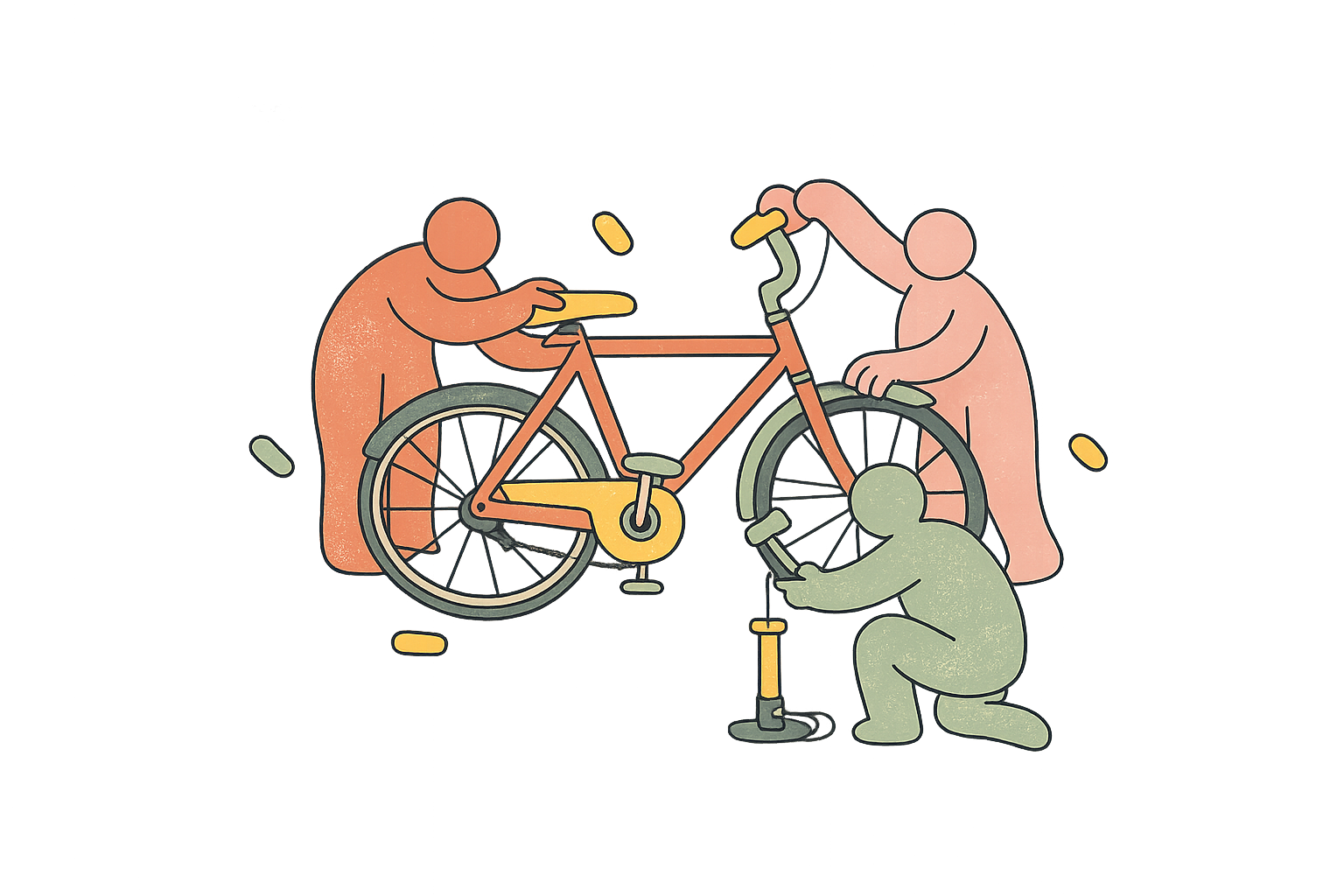
There are cities held together by law, by money and by surveillance. Then there are cities that continue, rather improbably, on the strength of tiny, unrecorded acts of restraint. An old bicycle left unlocked outside an apartment block ought to belong to the first category: a thing so vulnerable that only a fool would trust it to the street. Yet sometimes it slips into the second. It becomes, in practice, neither wholly private property nor fully abandoned object, but a modest common resource—used by strangers, maintained by them, and returned with a rough fidelity to where it came from.
That is what makes the story of the old bicycle so arresting. Its owner does not lock it because it is too shabby to be worth stealing. It is cheap, already old, and only intermittently useful. For months it remains untouched, or seems to. Then one morning it disappears. By afternoon it is back, standing neatly where it always stood. Later, closer attention reveals a pattern: the saddle rises and falls according to the height of unseen riders; a loose seat suggests hasty adjustments; a flat tyre is mysteriously reinflated by the next day. The bicycle is not being stolen in the conventional sense. It is being borrowed by a silent public.
Modern urban life is supposed to make this impossible. The dominant account of city living insists that anonymity erodes obligation. What is unattended will be taken; what is shared will be neglected; what belongs to everyone will soon belong to no one. Yet scholars of the “commons”, most famously Elinor Ostrom, spent decades showing that communities often manage shared resources successfully without either privatisation or heavy-handed state control. Her examples were forests, fisheries and irrigation systems, but the principle scales down remarkably well. A bicycle can become a commons in miniature if a local culture, however tacit, imposes rules: use it when you need it, do not ruin it, put it back.
There is a deeper urban lesson here. Jane Jacobs wrote that cities depend on countless small public interactions, habits and watchful routines that generate trust without intimacy. The old bicycle belongs to that world. No committee governs it. No app tracks it. No contract defines the rights of use. Even so, a social order has formed around it. Somebody takes it to run an errand. Somebody else pumps the back tyre. Several people, apparently, feel obliged to return it to the exact same place. The bicycle’s continued existence depends less on ownership than on a shared recognition that this small convenience should remain available.
That recognition is striking partly because it contrasts with more formal systems of sharing. Contemporary bike-share schemes rely on docks, GPS, payment systems and customer agreements because trust on a metropolitan scale is expensive to produce. When those systems fail, cities can end up with mountains of broken bicycles and a public soured on the promise of frictionless sharing. The unlocked old bicycle, by contrast, works precisely because it is local, legible and humble. Nobody imagines getting rich from it. Nobody mistakes it for a status object. Its value lies in use, not possession.
This does not mean the bicycle story is sentimental proof that private property is obsolete or that urban life is kinder than we think. Informal arrangements are fragile. One truly selfish person could end the experiment in a single afternoon. Yet fragility is part of the point. The bicycle survives because enough people choose, over and over, not to exploit the opportunity before them. The city reveals itself not only through grand infrastructure and public policy, but through these ordinary decisions made in stairwells, parking areas and courtyards.
An old bicycle, then, can become an index of civic health. It shows that between strict ownership and outright theft lies a broad, neglected territory of practical morality. In that territory, strangers recognise limits, preserve usefulness and sustain a tiny commons without ever naming it as such. The miracle is not that the bicycle vanished and returned. The miracle is that, in a city full of private need, so many people agreed to leave something behind for the next person.
Citations:
Elinor Ostrom, Nobel Prize materials; OECD reports on urban commons and commons governance; Springer research on commoning practices in streetscapes; Urban Studies research on cycling, bicycle parking and theft; historical research on the origins of bike-sharing.