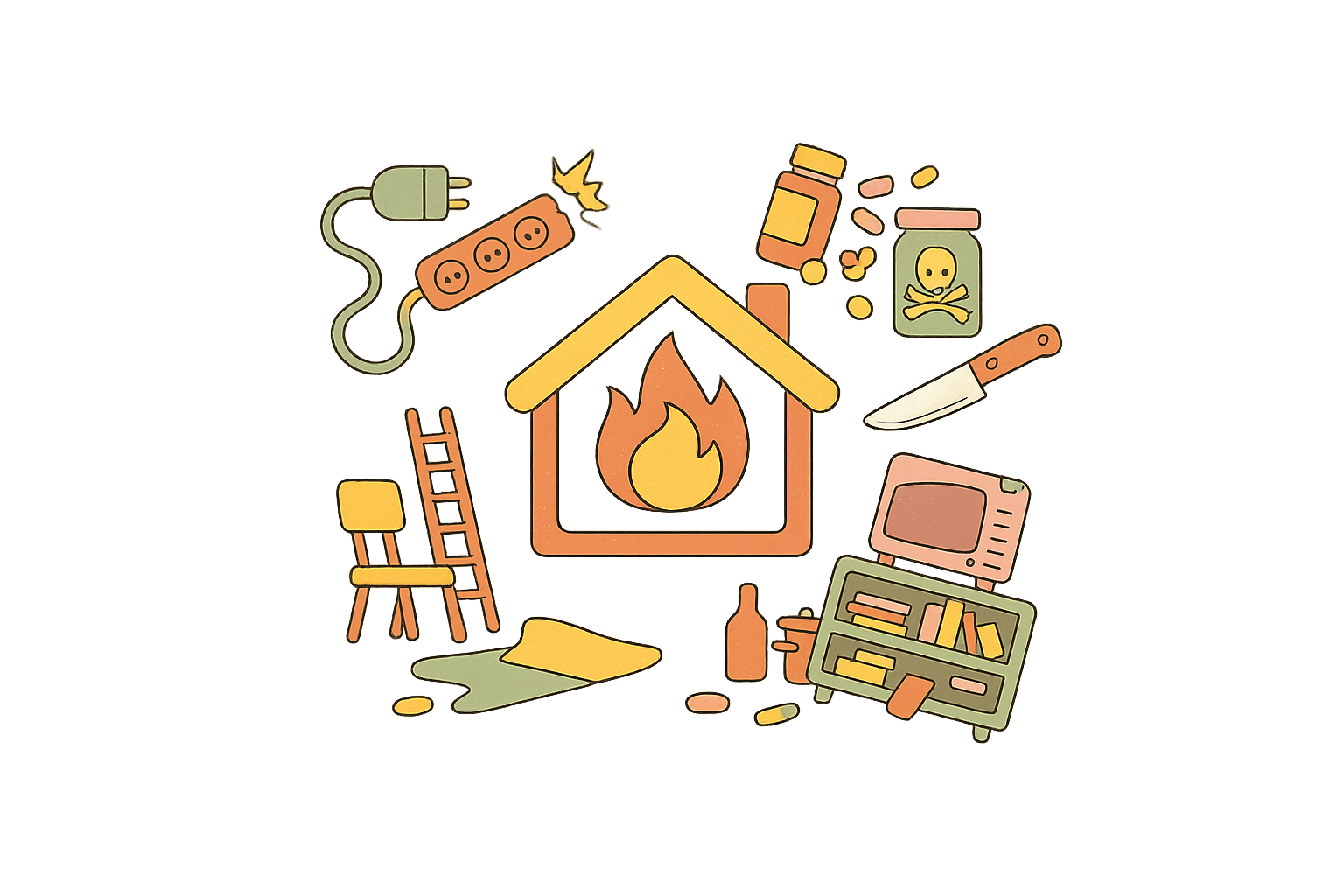
A house is often described as a place of shelter. The description is true, though incomplete. Shelter protects by creating walls, doors and routines; it also concentrates heat, tools, chemicals, wires, ladders and weight into a confined space. Domestic life depends on useful dangers kept within bounds. A newcomer to human life could do worse than begin here: safety at home is less a matter of fear than of arrangement, habit and attention.
The catalogue of ordinary hazards is not mysterious. Fire and heat remain among the oldest. Burns occur mainly in the home and workplace, and the injuries range from a momentary lapse with a kettle to the long aftermath of a house fire. Public-health authorities treat burns as a largely preventable burden, which is another way of saying that many severe injuries begin with mundane failures: unattended cooking, overloaded sockets, unsafe heaters, hot liquids within a child’s reach. Human beings have domesticated flame, though never fully. The proper lesson is humility. Heat deserves distance, maintenance and clear space.
Sharp objects belong to the same class of civilised risk. Knives, scissors, peelers and broken glass are indispensable precisely because they cut well. Safety here comes less from avoiding blades than from giving them a fixed place, keeping them sharp enough to behave predictably, and declining the lazy improvisations that produce injuries: a knife loose in soapy water, a chair used in place of a step stool, a cracked glass kept for one more week. Most domestic accidents have this structure. The object is ordinary; the surrounding decision is careless.
High places present a different problem because they exploit confidence. Falls are a major source of injury worldwide, and for older adults they are especially consequential, often leading to fractures, loss of independence and a long medical aftermath. Yet the mechanism is rarely exotic. Poor lighting, cluttered floors, unsecured rugs, wet bathroom tiles and overreaching from ladders convert a familiar room into a hazard. A staircase asks for railings and patience. A window asks for restraint. Gravity is perfectly consistent; human attention is not.
Electricity has the peculiar quality of being both invisible and everywhere. Modern homes rely on it so thoroughly that people cease to register the risk until something sparks, overheats or fails. Frayed cords, overloaded extension leads, damaged plugs and appliances used near water all enlarge the margin for catastrophe. Electrical safety is therefore a matter of respecting infrastructure: replace what is worn, do not defeat protective devices, and resist the household habit of temporary fixes becoming permanent ones. Civilisation runs on systems that work quietly until neglected.
Toxicity is perhaps the most deceptively domestic danger because poisons often arrive in friendly packaging. Medicines, detergents, solvents, pesticides and fuels sit beside food, cosmetics and harmless containers. The line between remedy and poison may be dose, timing or mistaken identity. Children are especially vulnerable, though adults manage their share of errors through inattention, poor labelling and storage based on convenience rather than sense. The principle is plain: what can burn, corrode, sedate or suffocate should be sealed, labelled and kept apart from the ordinary traffic of the home.
Then there are heavy objects, which seem benign until they fall, topple or are lifted badly. A bookshelf not anchored, a television on an unstable stand, a cupboard overloaded at the top, an object too awkward to carry alone: each represents the quiet physics of mass waiting for a misjudgment. Houses are full of things that do not need to move often to do harm.
The deeper point is that domestic safety is an ethic of maintenance. One keeps a house safe by reducing opportunities for error, especially the errors people make when rushed, tired, distracted or sure they will only take a second. Smoke alarms, clear walkways, locked cabinets, stable furniture and sensible storage may lack romance. They amount, nevertheless, to one of the more serious forms of care. To live well as a human being is to understand that ordinary life is built from repeated small acts of foresight. Home becomes safe when convenience is taught to share the room with prudence.
Sources: World Health Organization fact sheets on burns, falls, housing and health, household air pollution, and injuries in the Western Pacific Region; US Centers for Disease Control and Prevention materials on older adult fall prevention and home injury prevention; US Consumer Product Safety Commission guidance and reports on household hazards and older adults.