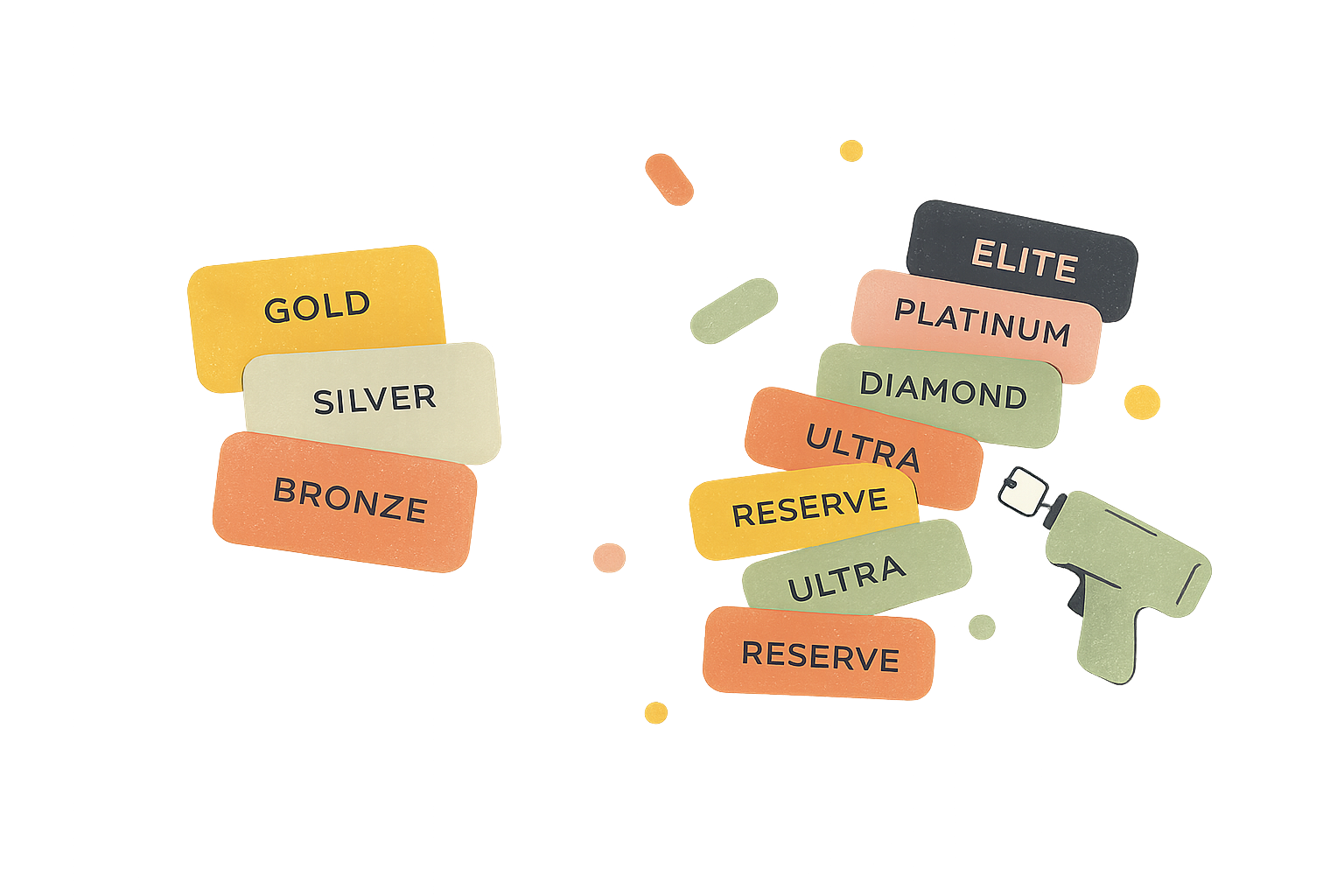
There was a time when social ranking had the decency to stop at gold. Bronze, silver, gold: a tidy little hierarchy, inherited from medals, coinage and the Olympics, in which even losers could console themselves that at least the system made sense. Now one cannot buy a sandwich, board a plane or subscribe to a streaming service without being invited into a taxonomy of absurdity: platinum, diamond, black, ultra, signature, reserve, elite, executive. Somewhere in a marketing department, a thesaurus is being beaten to death.
This is not merely a linguistic annoyance. It is a small parable of how modern commerce works. Loyalty programmes and premium branding were once meant to distinguish meaningful gradations of service. Airlines and hotels long relied on relatively comprehensible ladders—silver, gold, platinum, diamond—each tier tied, at least in principle, to more spending and better treatment. Cathay, for instance, has long used Green, Silver, Gold and Diamond, and Hilton has recently gone further still by unveiling a new “Diamond Reserve” tier above Diamond. ([news.cathaypacific.com](https://news.cathaypacific.com/cathay-membership-becomes-smoother-simpler-and-better-3btnyy?utm_source=openai)) The escalation is the point. Once everyone has a gold card, gold ceases to glitter.
Economists have a name for the instinct being exploited here. Thorstein Veblen, writing in the 19th century, argued that consumption is often less about utility than about status: people value goods partly because they signal rank. Britannica’s summary of conspicuous consumption captures the essence neatly: advertising helps create desire for things whose use displays prestige. ([britannica.com](https://www.britannica.com/quotes/Thorstein-Veblen?utm_source=openai)) If status is relative, however, it can never sit still. A company that once sold “premium” must invent “premium plus”; a firm with gold must create platinum; one with diamond must conjure black diamond, because the commercial world cannot tolerate a settled summit.
The result is inflation without improvement. Language that once denoted rarity is debased by overuse. “Elite” no longer means elite if half the airport is invited to board early. “Exclusive” is less exclusive when it arrives by email to millions. The more crowded the premium category becomes, the more businesses must subdivide it to preserve the sensation of distinction. This is why every hierarchy now resembles a feudal court, thick with dukes, viscounts and hereditary nonsense.
There is also a democratic insult embedded in all this. These labels flatter consumers by pretending to confer honour, while mostly describing a pricing strategy. One is not a “diamond member” in any morally serious sense; one has simply spent enough on hotel rooms or flights to be nudged towards spending more. The rhetoric of prestige disguises a banal commercial truth: tiering is a machine for sorting customers by profitability and making each group crave the privileges of the next. ([store.hbr.org](https://store.hbr.org/product/the-loyalty-effect-the-hidden-force-behind-growth-profits-and-lasting-value/4480?utm_source=openai))
So yes, we endure these shenanigans because the language of status has become one of the cheapest tools in modern marketing. It costs little to mint a new adjective and a darker-coloured membership card. But perhaps the consumer’s revenge is simple mockery. Once “black diamond reserve executive elite” sounds as ridiculous as it is, the spell weakens. Gold was enough. The rest is merely rhetorical quantitative easing.