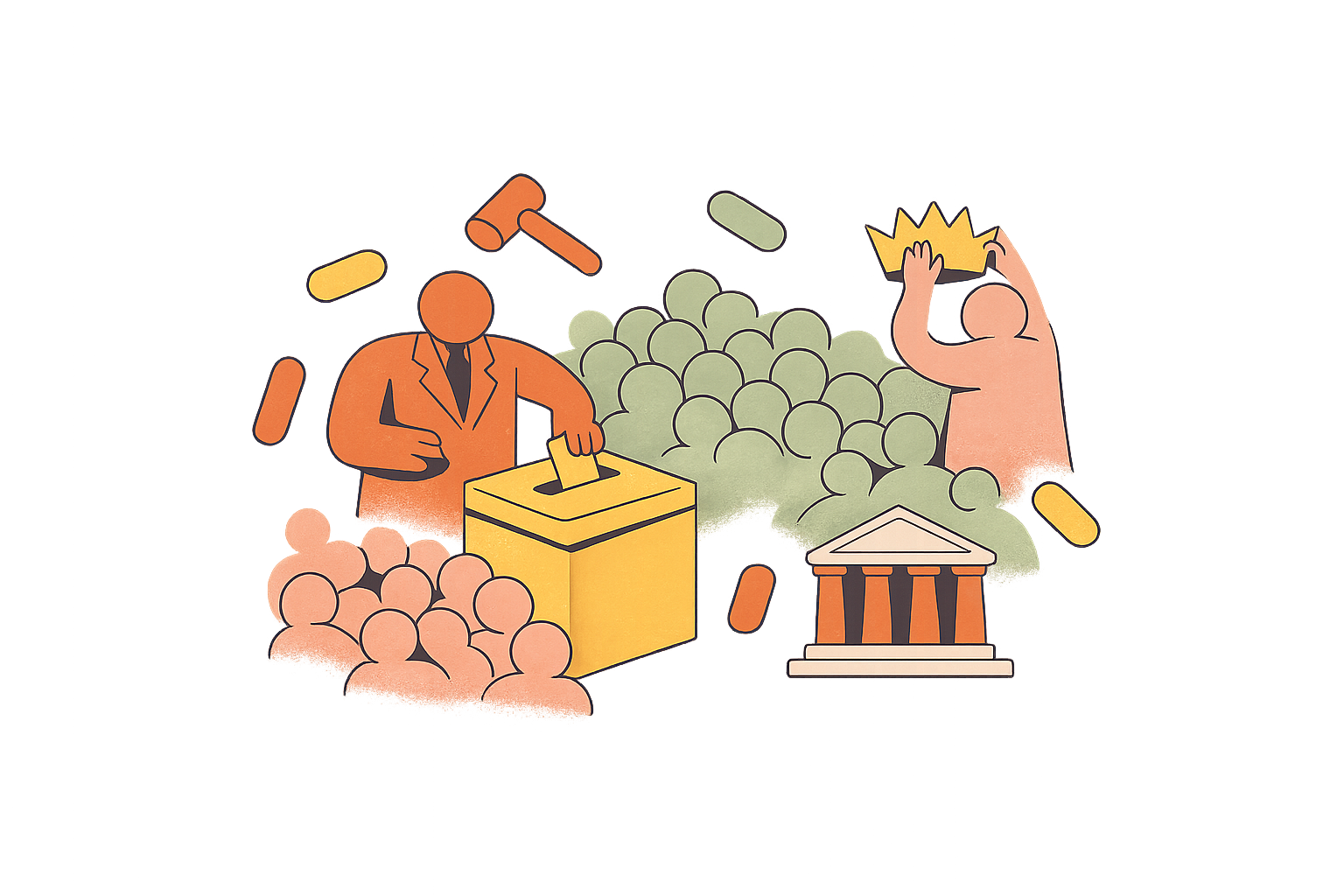
Democracy’s great strength is also its permanent vulnerability. It rests on an ennobling premise: that political legitimacy should not descend from blood, wealth or priestly authority, but rise from the consent of ordinary citizens. Yet the history of modern politics suggests that any system built to distribute power can also be captured by those most adept at concentrating it. Socialism, in many places, began as a moral protest against exploitation and hierarchy; in the hands of revolutionary zealots, it often hardened into a machinery of command. Democracy, for all its virtues, is not exempt from a similar corruption.
The danger is not the vote itself, still less the principle of political equality. It is the illusion that mass participation alone guarantees wise or decent government. Elections are a mechanism, not a moral vaccine. They can elevate statesmen; they can also enthrone demagogues. Political scientists have spent the past decade documenting how democratic backsliding increasingly occurs not through coups but through ballots: leaders win office legitimately, then weaken courts, bully the press, hollow out civil society and rewrite rules to make themselves harder to remove. The costume remains democratic; the substance grows illiberal.
Populism thrives in precisely this gap between democratic form and democratic purpose. It presents itself as the pure voice of “the people” against corrupt elites, and in that accusation there is often a seed of truth. Technocratic complacency, inequality and institutional arrogance do indeed breed resentment. But the populist move is to turn grievance into licence: to suggest that because institutions are flawed, constraints themselves are illegitimate; that because experts err, expertise is worthless; that because opponents disagree, they are enemies of the nation. What begins as a complaint against unresponsiveness becomes a crusade against pluralism.
This is where universal suffrage reveals its fragility. The franchise is just and necessary, but it does not suspend the facts of human psychology. Large electorates are susceptible to spectacle, simplification and myth, especially in an age of algorithmic outrage. The candidate who offers complexity, trade-offs and delayed rewards is at an obvious disadvantage against the one who offers villains, slogans and instant redemption. Social media has intensified this asymmetry, rewarding emotional certainty over sober judgment and personal charisma over institutional restraint. The result is not that voters are inherently foolish, but that politics increasingly favours those skilled at manipulating attention rather than governing reality.
Still, the answer cannot be less democracy, but better-defended democracy. A mature democratic order depends on buffers against the passions of the hour: independent courts, professional civil services, free media, strong local institutions, civic education and a political culture that accepts defeat as legitimate. Democracy fails when it is treated as mere arithmetic, as if 50 per cent plus one confers moral infallibility. Liberal democracy, at its best, is not simply majority rule. It is majority rule hemmed in by law, rights and institutional memory.
The lesson, then, is both sobering and hopeful. Popular sovereignty is indispensable, but it is not self-sustaining. A society that teaches citizens only that their voice matters, and not that truth matters, restraint matters and institutions matter, leaves itself open to seduction by the loudest flatterer. Democracy is a noble instrument. But like any instrument, it can be played beautifully or used as a cudgel. The choice depends less on whether everyone may vote than on whether a nation has built the civic discipline to resist those who would turn the people’s will into a weapon against the people themselves.