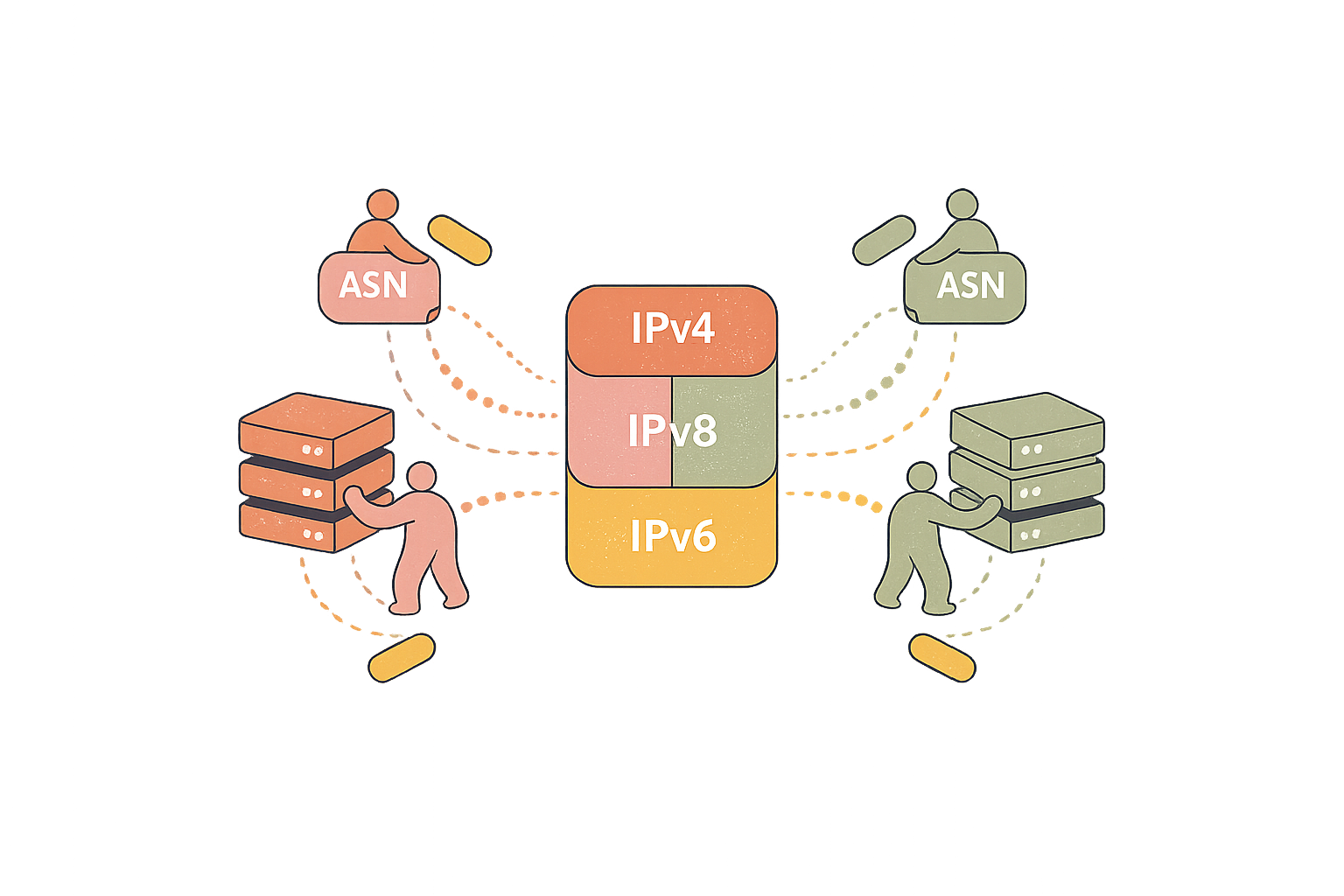
The newly filed IETF draft on “IPv8” has attracted attention for a simple reason: it speaks to a very old frustration. After three decades of IPv6, the internet still lives in an awkward halfway house. IPv4 persists behind layers of NAT and carrier-grade workarounds; IPv6 is real and substantial, though unevenly deployed. Into that fatigue comes a proposal that promises elegance, compatibility and administrative order in one stroke.
The draft’s central idea is superficially attractive. It defines a 64-bit address made of two halves: a 32-bit routing prefix tied to an autonomous system, and a 32-bit host portion that preserves familiar IPv4 semantics. In the proposal, an address whose routing prefix is zero is treated as ordinary IPv4. That allows the author to claim full backward compatibility with the installed base while also offering a much larger addressing framework. Each ASN, under this model, would receive more than four billion host addresses, and the global routing table would in theory be bounded by the number of ASNs rather than today’s sprawl of prefixes.
That is the sort of design that makes network engineers pause. It is easy to see the appeal. The draft also goes much further than address format. It imagines a tightly managed protocol suite in which devices receive everything they need through a single lease response; identity is bound to OAuth-style tokens; route validation, logging, translation and access control are all folded into a coherent architecture. In spirit, this reads less like a narrow IP revision and more like a complete replacement programme for the untidy internet that actually exists.
That ambition explains both the curiosity and the scepticism. The early reaction among practitioners has been less admiration than wary amusement. Some comments have treated the draft as an expression of industry exasperation with dual stack and transition costs rather than as a plausible standards path. Others have compared it to the old tendency to answer entrenched complexity by inventing a new universal standard, thereby producing one more standard. A few found parts of the concept clever, especially the effort to preserve IPv4 familiarity. Even sympathetic readers tend to add the same caveat: perhaps this would have been an interesting road not taken in the 1990s; in 2026 it arrives too late.
That judgment rests on more than conservatism. IPv6 may be slow, but it is no longer hypothetical. By March 2026, Google reported that roughly 48% of requests to its services were being made over IPv6, while APNIC’s figures for mid-March to mid-April 2026 put global IPv6 capability above 43%. Those numbers do not describe a failed protocol. They describe an incomplete migration, with all the messiness that implies. The practical question for operators is whether the world is more likely to replace a partly deployed standard with a brand-new architecture that also demands fresh support across operating systems, applications, routers, management tools and governance systems. The answer is fairly plain.
The stronger reading of the IPv8 draft, then, is sociological rather than technical. It exposes a broad impatience with the internet’s piecemeal condition. Administrators dislike running two protocol worlds at once. Enterprises dislike renumbering, retraining and troubleshooting edge cases. Everyone dislikes transition mechanisms until they become invisible. The draft packages those grievances into a single, highly ordered vision. That alone has made it worth reading.
Still, standards do not succeed because they are neat on paper. They succeed when deployment can be staged, incentives align, vendors implement, and operators can survive the transition. By that measure, IPv8 looks less like the next chapter of the internet than a pointed critique of the current one. It is a reminder that IPv6 won the standards battle long ago, yet never managed to feel politically or operationally finished. The internet may not adopt this proposal. It may nevertheless recognise the complaint behind it.
Citations: IETF Datatracker draft-thain-ipv8-01; Reddit discussion in r/networking on the new IETF IPv8 draft; Habr commentary on the IPv8 draft and 2026 IPv6 deployment figures.